
 Solar Inverter
 Hybrid Inverter
 Power Inverter
 Split Phase Inverter
 Energy Storage Inverter

 3 Phase Inverter
 Solar System Kits
 Solar Charge Controller

 Solar Battery
 Asia
Asia
 Africa

 South America
 Europe
 North America

 Oceania & Antarctica


 Inquire

 Home
HomeWhat is the Time of Use Charging and Discharging Function of Parallel Hybrid Inverter?
 Jan 30,2026

 XINDUN
With continuously rising energy costs leading to high electricity expenses and unstable supply, many overseas households are choosing to install solar power system to achieve independent power supply and save on electricity bills. However, during the utilization of solar energy, the timing of charging and discharging, as well as how to make the solar power system operate more efficiently and economically, have become key concerns for many overseas users.
Addressing this pain point, the time of use charging function of the parallel hybrid inverter allows users to flexibly set charging strategies based on differences in electricity prices and solar output at different times. This function has three customizable time of use settings, which can automatically dispatch power according to your electricity consumption habits, solar power generation status, and local peak and off peak electricity prices, achieving the triple goals of saving electricity, saving money, and saving worry.
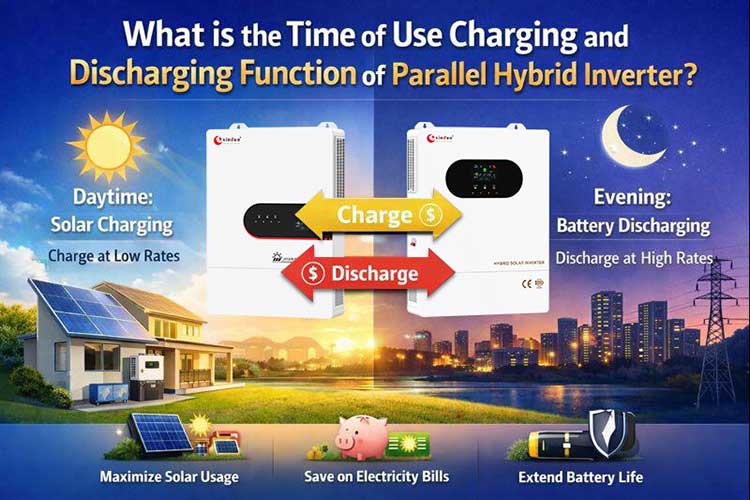
I. What is time of use charging and discharging?
Simply put, this is time driven energy dispatching function. You can preset multiple time periods and specify which energy source (mains power, solar power, or battery) the inverter should prioritize using during those periods. This allows the inverter to charge and store energy when electricity prices are low and discharge for self use when prices are high, maximizing energy efficiency.
II. The benefits of time of use charging and discharging
Time of use charging and discharging is not simply timed switch, but design focused on optimizing energy allocation. By setting up time of use charging and discharging, it can reduce electricity costs, increase solar self consumption rate, and extend battery life.
1.Cost Reduction and Efficiency Improvement
Based on local peak and off peak electricity prices, during off peak hours (e.g., late at night to 10:00 PM – 6:00 AM), priority is given to charging the battery, during peak hours (e.g., daytime peak electricity consumption 8:00 AM – 12:00 PM, and expensive electricity periods 6:00 PM – 10:00 PM), priority is given to discharging the battery to power the load, avoiding high priced grid electricity. This helps users charge when electricity prices are low and discharge when prices are high, significantly reducing electricity costs.
2.Battery Protection
Time of use charging and discharging, through precise control of charging and discharging periods and thresholds by the inverter, avoids overcharging, over discharging, and frequent charging and discharging, reducing cycle losses, extending the lifespan of lead-acid and lithium battery, and reducing safety risks such as battery bulging and leakage caused by improper charging and discharging conditions, further improving the stability and safety of battery use.
3.Optimize energy utilization
Prioritize the consumption of solar power and store the power charged during peak hours during off peak hours to achieve synergy and complementarity among solar, grid power, and battery, thereby improving overall energy utilization efficiency.
III. Application introduction of time of use charging and discharging function
The time of use charging and discharging function of the parallel hybrid inverter includes two main modules: "time of use AC charging and loading" and "time of use battery discharging." Each module supports setting up to three independent time periods. Each time period can be flexibly set within the range of 00:00–23:59 to meet the user's power needs at different times.
1.Time of use charging and loading:
The core of time of use charging and loading is prioritizing the consumption of solar energy and storing electricity during off peak hours when electricity prices are low, thus charging and storing energy at the lowest possible cost.
Solar Priority Consumption: During the designated time period, if the solar system outputs energy, the inverter will prioritize using solar power to charge the battery and supply power to the load, avoiding waste of solar energy.
Mains Supplementation: When solar energy is insufficient (e.g., on cloudy days or in the evening) or there is no solar output, grid supplementation is automatically activated, both to charge the battery (storing low priced electricity) and to ensure stable load operation (avoiding power outages).
Typical Scenario Adaptation: If the local mains price is low during off peak hours (e.g., 11:00 PM - 7:00 AM), this period can be designated as the "mains charging or loading period." During the day when solar is abundant, solar directly powers the load and charges the battery, at night during off peak hours, low priced mains is used to supplement the battery, storing energy for the next day's peak electricity consumption.
2.Time based battery discharge
The core of time of use battery discharge is to discharge the battery during peak hours and then switch to mains power as backup when the battery is low.
Battery Priority Load: During designated time periods (e.g., peak daytime electricity consumption, periods with high electricity prices), the inverter prioritizes battery discharge to power the load, avoiding the use of high priced mains power during these periods.
Automatic Mains Power Backup: If the battery power is insufficient (e.g., battery SOC below 5%, voltage below the over discharge threshold), the system will seamlessly switch to mains power to ensure uninterrupted operation of critical loads such as refrigerators and air conditioners.
Typical Scenario Adaptation: If local mains power price is high during peak hours (e.g., 8:00-22:00), this period can be designated as "battery discharge period": the solar system charges the battery during the day, and the battery discharges during peak hours, with mains power only used to supplement the battery when it is low, minimizing the consumption of high priced electricity.
IV. Precautions for using the time sharing charging and discharging function
1. Time Period Conflict Prevention: Charging and discharging periods must not overlap (e.g., if "23:00-06:00" is set for charging, it cannot be set for discharging simultaneously). Otherwise, the system will prioritize charging, causing the discharging function to fail.
2. Load Adaptation: If the discharging period needs to power inductive loads such as motors (starting power 2-3 times the rated power), ensure sufficient battery capacity to avoid voltage drops triggering protection during discharging.
3.Regular Checks: Check monthly to ensure the time period settings match the latest peak valley electricity pricing policy (if electricity price periods change, the inverter time periods must be modified accordingly). When the system is not in use for extended periods, it is recommended to enable "timed charging" (e.g., charging once every 3 months) to prevent the battery from being stored with a low charge.
Recommended Xindun Power split phase inverter
Our 10KW/12KW HU and HP PLUS+ series parallel hybrid inverter feature time of use charging and discharging settings, helping users balance grid load, reduce dependence on the public grid, and ensure continuous and stable household electricity supply in situations of unstable energy supply by rationally planning battery charging and discharging times, thus enhancing the autonomy and flexibility of energy use.
The time of use charging function is a very useful feature, allowing users to reduce household electricity bills, efficiently utilize solar power, extend battery life, and improve the economics and stability of the solar power system.
Meanwhile, the HU and HP Plus+ are high frequency parallel hybrid inverter with built in MPPT solar controller, supporting maximum solar input voltage of up to 500Vdc. Under varying light conditions, the system maintains high efficiency, reduces energy loss, and improves the reliability and continuous output capability of solar power generation. They also support battery-free operation (single unit).
However, the two products target different power standards and application markets, allowing for better matching to different regions.
The HU series inverter is US standard split phase inverter, suitable for dual voltage regions using US standard power system, such as South America. It offers both split phase input and split phase output, or single phase input and single phase output modes, employing a high frequency design for efficient inverter conversion.
When operating in parallel, the split phase inverter provides four parallel output modes: single phase parallel output, 2 phase split phase parallel output, split phase parallel output, and three phase parallel output. Parallel output is possible in both split phase and single phase operation modes, providing users with significant flexibility and scalability.
The HP PLUS+ series inverter is European standard parallel hybrid inverter, supporting single phase or three phase parallel operation. It is suitable for regions with 220V/50Hz voltage standards, such as Europe, the Middle East, Africa, and some Asian countries. This series meets residential power needs while allowing for system capacity and output power expansion through parallel connection. It is suitable for residential and small commercial applications with three phase loads or higher power requirements, providing users with a stable and scalable solar energy storage solution.
If you would like to learn more about Xindun Power split phase inverter, you can leave your information and needs in the customer service window at the bottom of the website(https://www.xinduninverter.com/). Xindun Power will contact you as soon as possible during working hours.
 How Does Split Phase Hybrid Inverter Distribute Load Power Across Its Dual Voltage Output?
 Top Selling Products













 WeChat
 Email
Email WhatsApp