
 Solar Inverter
 Hybrid Inverter
 Power Inverter
 Split Phase Inverter
 Energy Storage Inverter

 3 Phase Inverter
 Solar System Kits
 Solar Charge Controller

 Solar Battery
 Asia
Asia
 Africa


 South America
 Europe
 North America
 Oceania & Antarctica


 Inquire
 Home
HomeLow vs High Voltage Batteries for Solar Inverters | Xindun Power
 Jun 09,2026

 XINDUN
As the core power conversion device in a photovoltaic energy storage system, the DC-to-AC inverter relies heavily on the DC input voltage of its battery for system selection and installation. Battery voltage directly determines the inverter's rated power, operating current, line losses, operational stability, and applicable scenarios. Through long-term development, the industry has established a globally universal and standardized battery voltage configuration system. Different voltage levels correspond to inverters with different power ranges and cannot be arbitrarily mixed.
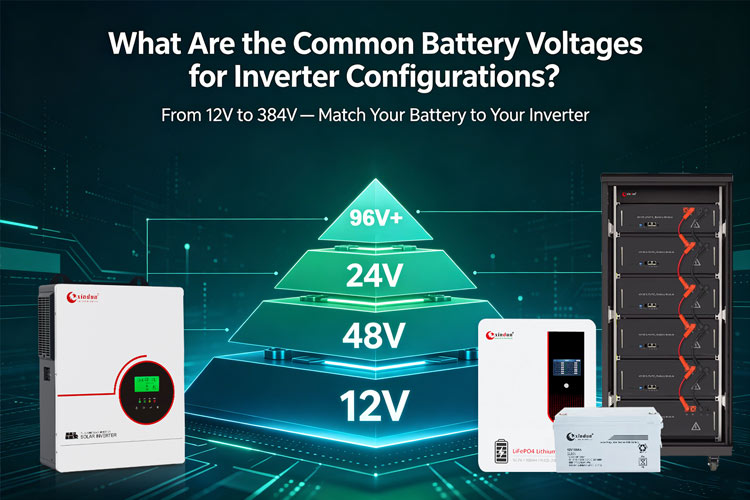
So, what are the common battery voltages for inverter configurations? Currently, the main battery voltages for inverters are divided into residential low-voltage mainstream voltages and industrial/commercial high-voltage voltages.
Mainstream voltage of household low-voltage batteries
12V, 24V, and 48V are the universally accepted low-voltage DC voltages in the global energy storage market. They are also the mainstream configurations for residential off-grid photovoltaic systems, home energy storage, and emergency backup power supplies. These are also the most common matching voltages for industrial frequency inverters, high-frequency off-grid inverters, and integrated photovoltaic inverter/controller systems on the market. Different voltages must be strictly matched to inverters of corresponding power ranges.
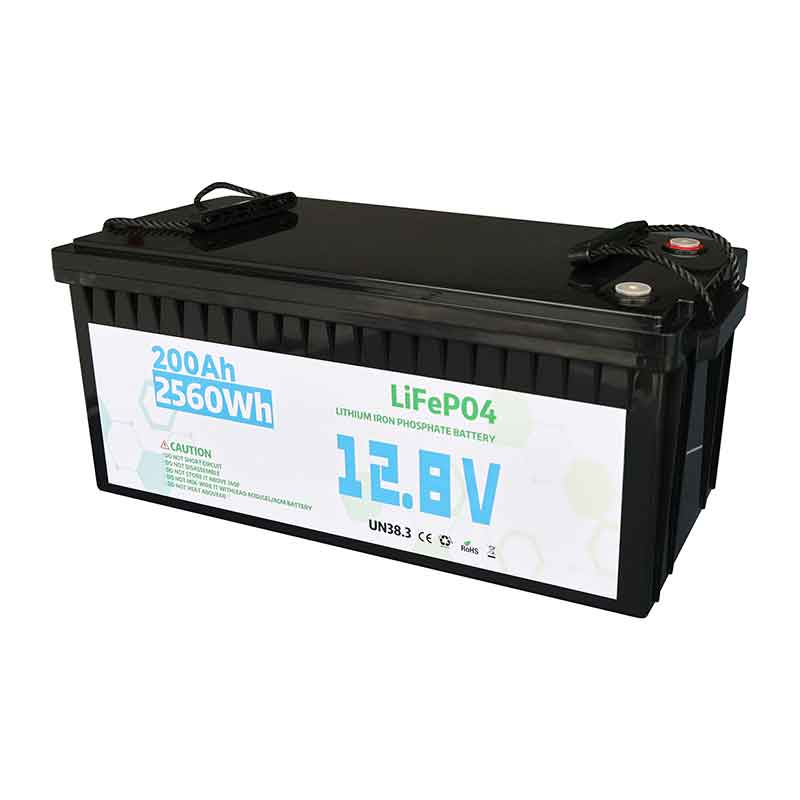
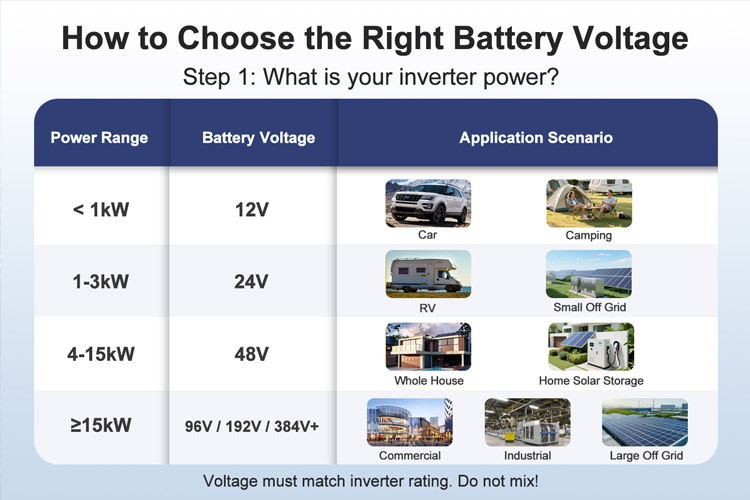
12V batteries are primarily compatible with low-power inverters under 1 kW. They feature safe low voltage, simple installation, and strong adaptability, making them widely used in vehicle inverters, outdoor camping power banks, small emergency lighting, backup power for small appliances, mobile phone and computer charging, and small independent photovoltaic power generation systems. They are the preferred voltage for entry-level residential energy storage.
24V batteries are compatible with 1-3 kW inverters. Compared to a 12V system of the same power, the 24V system's operating current is halved, resulting in reduced cable heating, lower voltage drop losses, and more stable inverter operation. They are often used in RV energy storage, small off-grid photovoltaic systems, and low-power emergency power supply in homes, offering a balanced choice between cost and performance.
48V batteries are mainly compatible with 4-15 kW inverters and are currently the most widely adopted and popular standard voltage in the global residential off-grid photovoltaic energy storage market. This voltage level offers higher conversion efficiency, lower heat loss, supports prolonged full-power operation, and allows for parallel expansion of multiple battery banks. It is perfectly suited for whole-house off-grid power supply, residential photovoltaic energy storage systems, and high-power household backup power supplies. It is currently the most widely used and prevalent battery voltage specification for residential energy storage.
Industrial and commercial high voltage battery voltage
96V, 192V, 384V, etc., high-voltage battery banks are specifically designed for use with high-power high-voltage inverters. High-voltage systems offer advantages such as low current, minimal transmission loss, strong high-power expansion capabilities, and high operating efficiency. They are primarily used in commercial and industrial energy storage power stations, large-scale photovoltaic energy storage systems, communication base station power supply, and large-scale off-grid power stations—professionally high-power energy storage scenarios.
Battery Selection Considerations
The inverter's rated DC input voltage must be completely consistent with the total voltage of the battery bank. Cross-voltage mixing is strictly prohibited. For example, a 12V inverter cannot be connected to a 24V/48V battery, and conversely, a high-voltage inverter must not be connected to a low-voltage battery! Voltage mismatch can lead to safety hazards such as equipment failure to start, triggering undervoltage and overvoltage protection, motherboard burnout, and system shutdown.
The higher the power output, the higher the battery voltage should be selected; for power outputs below 3000W, 12V batteries are not recommended. Hinton advises users to carefully review product parameters and confirm details with sales personnel during purchase. During use, please strictly follow the instruction manual to configure the battery voltage to meet the parameter standards.
Battery voltages are all globally standardized industry specifications. 12V, 24V, and 48V low-voltage residential batteries are the absolute mainstream in the market, corresponding to low-power, medium-power, and high-power residential scenarios, respectively; 96V and above high-voltage batteries are suitable for high-power commercial and industrial inverters of 15kW and above. Selecting the battery voltage corresponding to the inverter's power output ensures stable and safe equipment operation, minimizes line losses, and extends the lifespan of the entire energy storage system.
 Does a home hybrid inverter Need to Be Connected to the Grid?
 Top Selling Products













 WeChat
 Email
Email WhatsApp