
 Solar Inverter
 Hybrid Inverter
 Power Inverter
 Split Phase Inverter
 Energy Storage Inverter

 3 Phase Inverter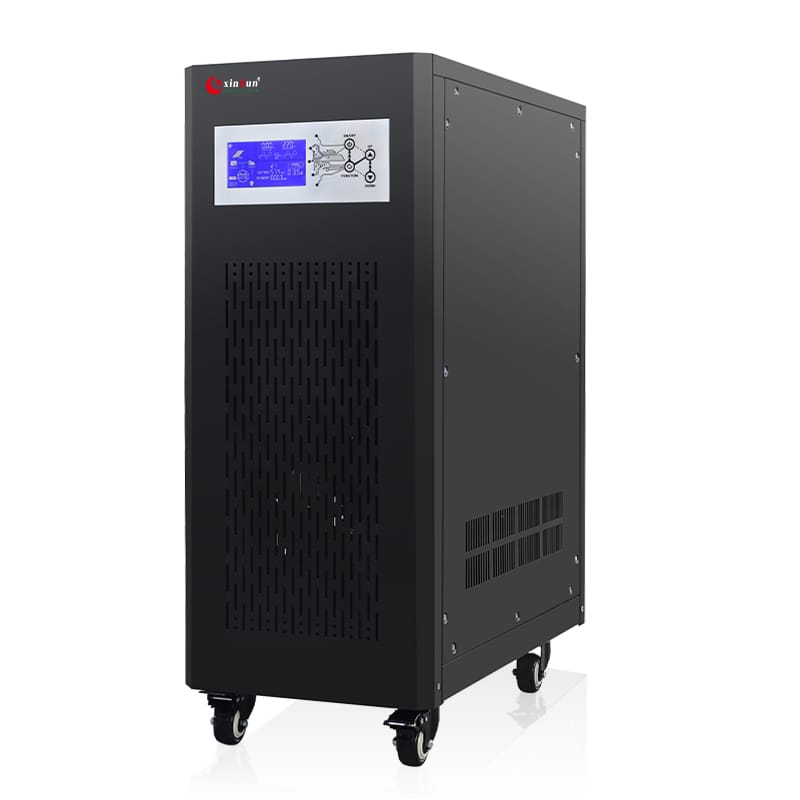
 Solar System Kits
 Solar Charge Controller

 Solar Battery
 Asia
Asia
 Africa



 South America
 Europe

 North America

 Oceania & Antarctica


 Inquire

 Home
HomeInverter Troubleshooting & Fault Code Guide | HDSX Three-Phase Off-Grid Inverter
 Jun 16,2026

 XINDUN
In industrial plants, commercial parks and other scenarios requiring high-power continuous power supply, three-phase off-grid inverters serve as core equipment to guarantee stable production and uninterrupted power. Effective inverter troubleshooting helps minimize downtime and prevent economic losses. They convert direct current (DC) generated by batteries and photovoltaic arrays into alternating current (AC) compatible with industrial equipment. Whether in cases of mains power outage, grid fluctuation, or operation in remote factories without access to public power grids, these inverters enable independent power supply. This prevents production line shutdowns and the resulting economic losses. When paired with photovoltaic energy storage systems, they also help enterprises cut energy costs and boost energy self-sufficiency. As essential devices for commercial and industrial off-grid power supply, backup power and photovoltaic energy storage systems, their operational stability directly impacts corporate production efficiency, equipment safety and operating benefits.
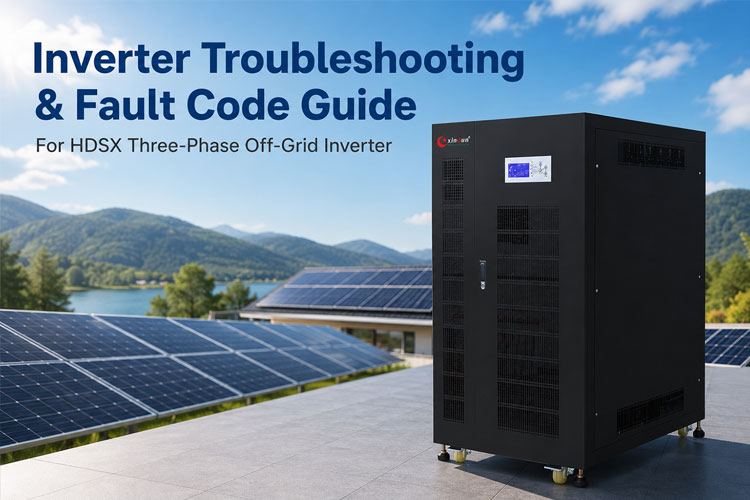
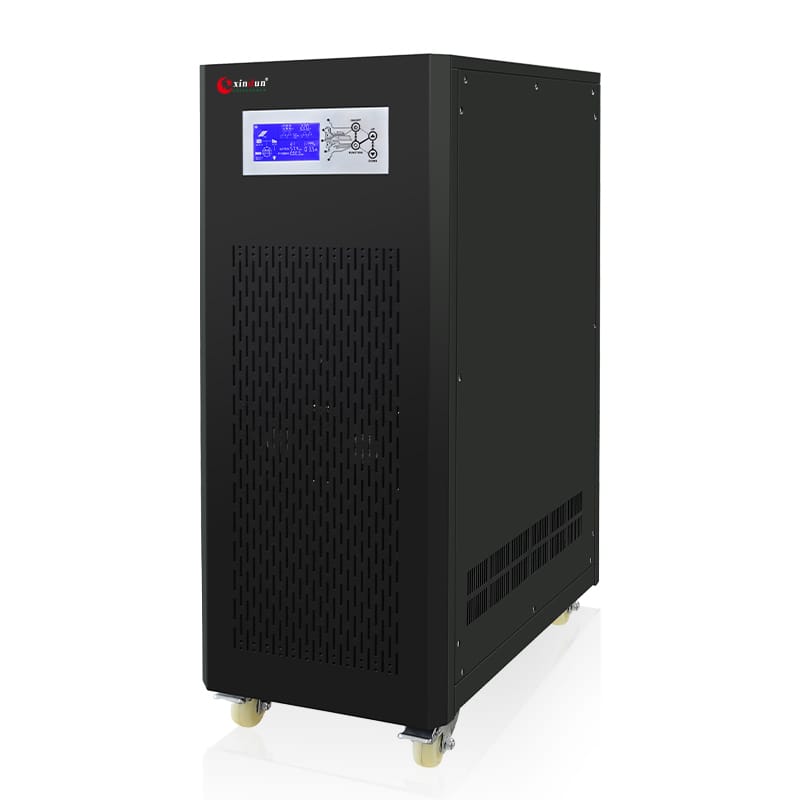
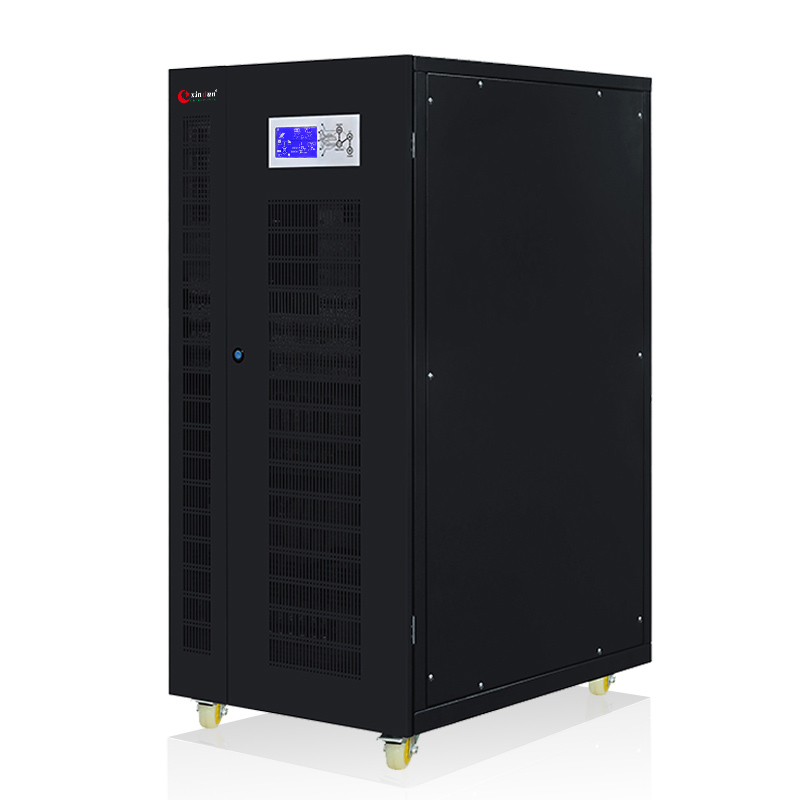
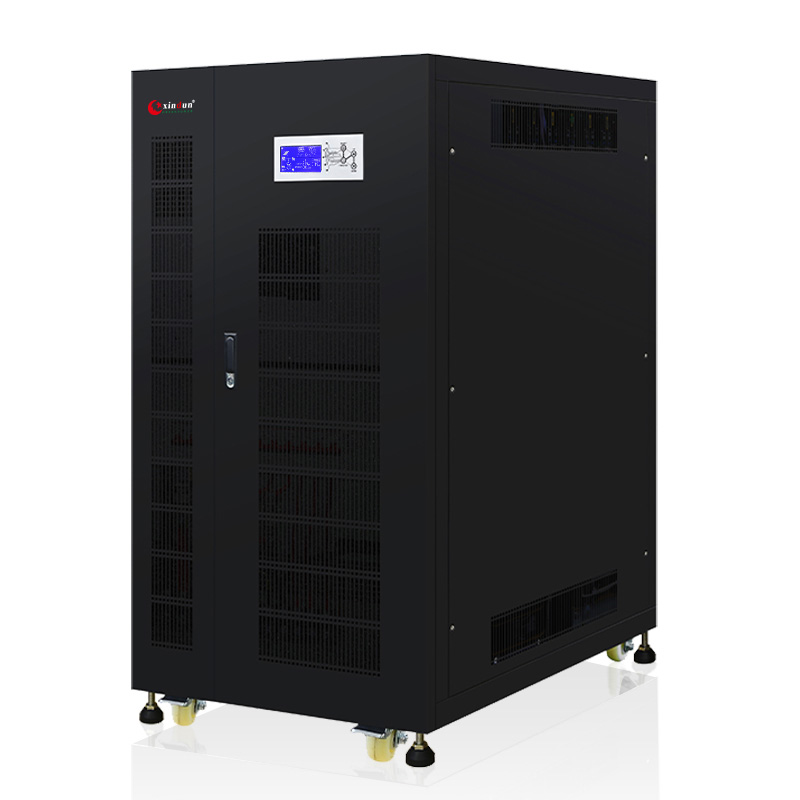
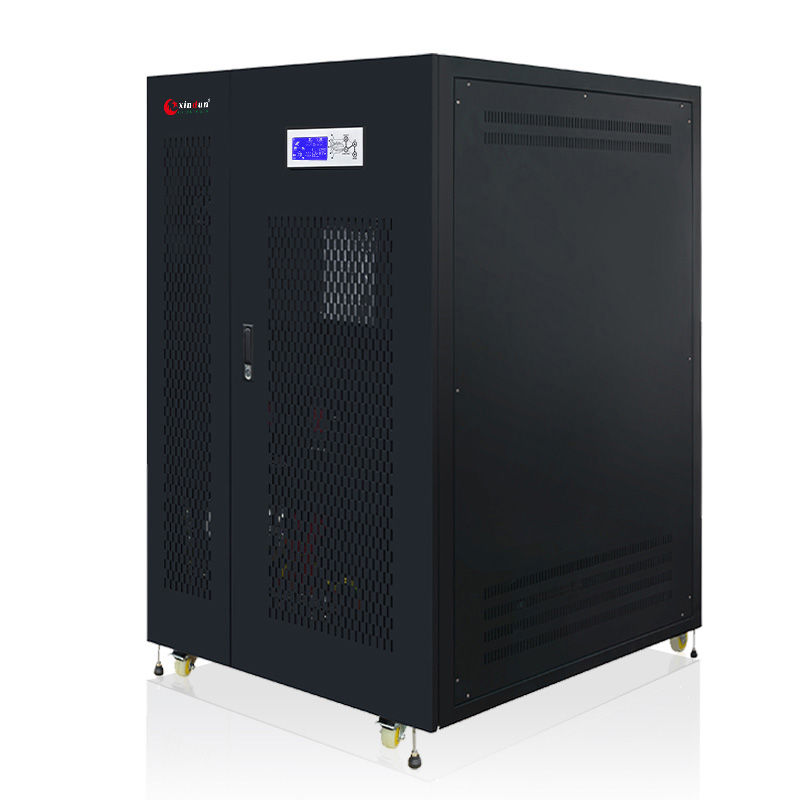
Commercial and industrial users generally demand inverters with high power and stable output. Regular inverter maintenance and proactive inverter fault analysis help ensure long-term operational stability. The Xindun HDSX off-grid three-phase inverter (3.2kW-160kW) is well-suited for commercial and industrial applications. Engineered for high-power and heavy-load industrial use, it delivers outstanding conversion efficiency and stable output performance.
This product supports unbalanced three-phase load operation and features a 3-in 3-out design. With pure sine wave output at power frequency and triple peak power capacity, it easily adapts to complex and diverse industrial operating conditions, delivering reliable power support for factories and enterprises. Built with an MPPT controller, it is compatible with various battery types to meet diverse power demands. Power can be supplied via photovoltaic panels, mains electricity or generators.
It also functions as a UPS. When mains power is available, the inverter stabilizes the voltage to power loads and charges the batteries simultaneously. Once mains power fails, it instantly converts DC power from batteries into AC power for seamless power supply. This ensures the continuous operation of critical loads and effectively prevents equipment damage.To help users quickly locate and resolve malfunctions, we have compiled a detailed inverter fault code list and corresponding solutions. When an inverter fault alarm occurs, the LCD screen displays codes starting with Axx — refer to the guide below to identify and fix the problem.
Common Fault Phenomena & Solutions
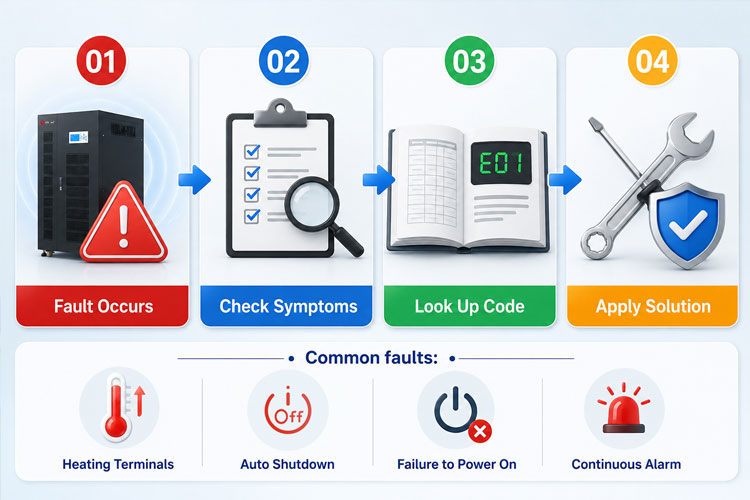
If the following visible faults occur during the operation of the Xindun HDSX off-grid three-phase inverter, follow the methods below for priority inverter troubleshooting to restore normal operation promptly.
1. Heating terminal blocks
Usually caused by poor contact or loose wiring terminals. Power off the device, then retighten all terminals to ensure firm connections.
2. Automatic shutdown under load
Mainly due to insufficient battery power or load power exceeding the rated value. Recharge the batteries or reduce the connected load before restarting the device.
3. Failure to power on
Generally caused by disconnected or poorly connected mains and battery cables. Inspect and securely reconnect all related lines.
4. Continuous alarm after power-on
Common causes include depleted batteries or overload. Recharge the batteries and cut down the load power. Resume operation after eliminating abnormalities.
Detailed Explanation of Alarm Codes
When the LCD screen displays alarm codes starting with Axx, the system has detected a corresponding inverter fault alarm. Refer to the content below to identify and fix the problem using this inverter fault code list.
(1) Battery Alarms
- A00: No alarm. The device is operating normally.
- A01: Battery overvoltage protection. Check for abnormal battery voltage.
- A02: Battery overvoltage alarm. Check for abnormal battery voltage.
- A03: Battery undervoltage protection. Switch to mains power supply and recharge the batteries in a timely manner.
- A04: Battery undervoltage alarm. Switch to mains power supply and recharge the batteries in a timely manner.
(2) Mains Power Alarms
- A05: Mains overvoltage protection 1. Check if the input mains voltage is too high.
- A06: Mains undervoltage protection 1. Check if the input mains voltage is too low.
- A07: Mains overvoltage protection 2. Check if the input mains voltage is too high.
- A08: Mains undervoltage protection 2. Check if the input mains voltage is too low.
- A09: Mains undervoltage alarm. Verify the stability and voltage level of input mains power.
- A10: Mains over-frequency. Check if the input mains frequency exceeds the standard range.
- A11: Mains under-frequency. Check for abnormal input mains frequency.
- A34: Abnormal phase sequence. Inspect for phase loss and adjust the input phase sequence.
- A35 / A36 / A37: Mains abnormality 1 / 2 / 3. Troubleshoot phase loss, voltage instability or voltage fluctuation of mains power.
- A39: Abnormal neutral line. Ensure consistency between input and output neutral lines.
(3) Inverter & Load Alarms
- A12: Inverter overvoltage protection. Please contact your supplier for assistance.
- A13 / A14 / A15: Phase A / B / C inverter overcurrent protection. Check for impact loads and reduce the load power.
- A22 / A23 / A24: Phase A / B / C load overcurrent protection. Cut down external loads to eliminate overload.
- A25 / A26 / A27: Phase A / B / C load overcurrent alarm. Cut down external loads to eliminate overload.
- A40 / A41 / A42: Abnormal output voltage of Phase A / B / C inverter. Please contact your supplier for assistance.
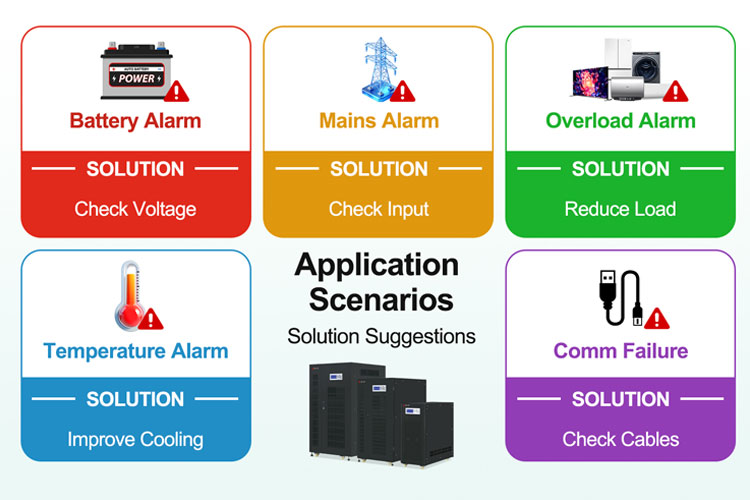
(4) Temperature & Sensor Alarms
- A16 / A17 / A18: Over temperature of Phase A / B / C inverter. Reduce the load and improve ventilation and heat dissipation.
- A19 / A20 / A21: Abnormal temperature detection of Phase A / B / C inverter. Replace the corresponding NTC temperature sensor.
(5) Hardware, Communication & Other Alarms
- A28: Hardware overcurrent protection. Contact your supplier for resolution.
- A29 / A30 / A31: Reversed wiring of Phase A / B / C transformer. Contact your supplier for resolution.
- A32: Manual shutdown via key. Normal operation, no handling required.
- A33: Communication failure. Inspect the communication cables. If the fault persists, contact your supplier.
- A38: Software overcurrent protection. Contact your supplier for resolution.
- A43: Remote shutdown. Normal remote operation, no handling required.
Conclusion
When alarm codes appear on the Xindun HDSX off-grid three-phase inverter, you may first refer to this inverter fault code list for quick lookup. Always disconnect mains power, batteries and photovoltaic input before troubleshooting to avoid electric shock hazards.
This inverter troubleshooting guide helps commercial and industrial users quickly respond to inverter fault alarms. Regular inverter maintenance and systematic inverter fault analysis are key to extending equipment life and ensuring reliable power supply.
If the fault cannot be eliminated with the above methods, or the alarm recurs frequently, record the fault code, operating environment and fault occurrence time, then contact your dealer or Xindun Power for professional technical support.
For more information about Xindun off-grid three-phase inverters, leave your contact details and requirements via the customer service window on our website. Our team will get back to you during working hours.
 Recommend some Chinese manufacturers of hybrid solar inverters with good quality and competitive price.
 Top Selling Products













 WeChat
 Email
Email WhatsApp