
 Solar Inverter
 Hybrid Inverter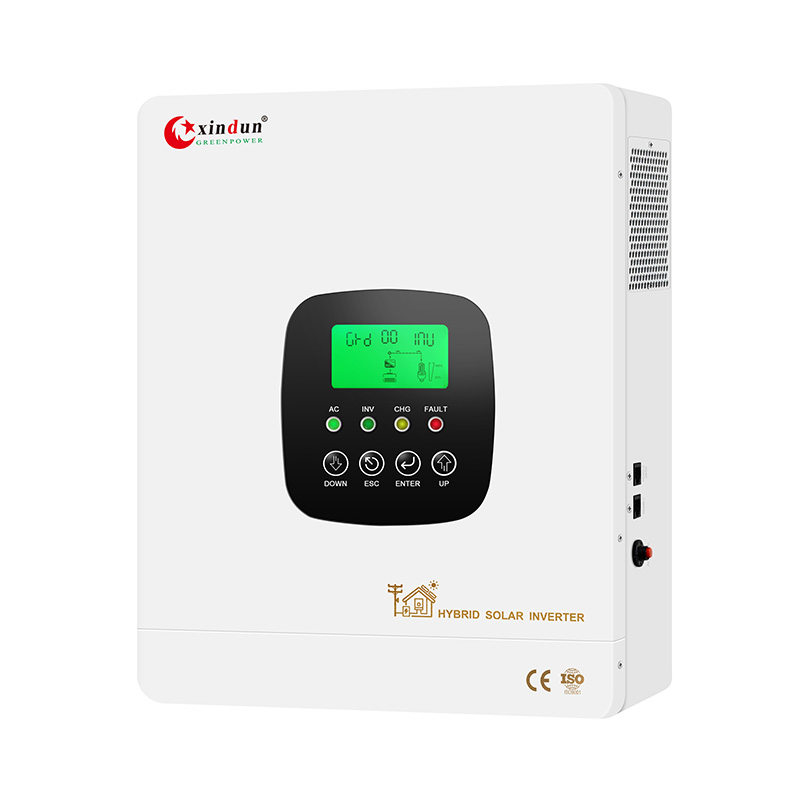
 Power Inverter
 Split Phase Inverter
 Energy Storage Inverter

 3 Phase Inverter
 Solar System Kits
 Solar Charge Controller

 Solar Battery
 Asia
Asia
 Africa

 South America
 Europe
 North America
 Oceania & Antarctica


 Inquire

 Home
HomeHow to Choose the Right Hybrid Inverter Output Priority?
 Aug 05,2026

 XINDUN
For long-term off-grid scenarios with no utility grid access, operating the hybrid on off grid inverter in off-grid mode is already widely recognized as the optimal choice. Whether you are selecting an off-grid hybrid solar inverter for a remote site — a system that essentially functions as a battery inverter off grid — getting the settings right is just as important as choosing the hardware.
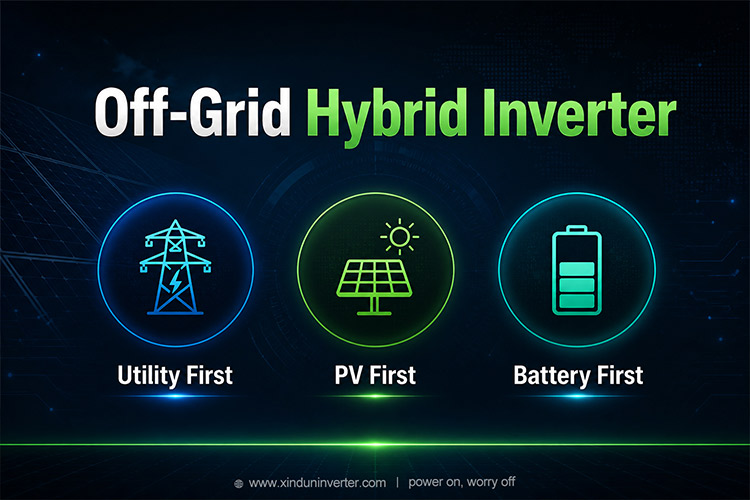
However, selecting the right mode is only the first step—to ensure that the energy dispatch between PV and batteries truly aligns with actual load demand, matching the output priority is equally critical. Different priority settings directly determine how solar energy and battery output are allocated, which in turn affects system operating efficiency and battery lifespan.
Below, Xindun provides an in-depth analysis of the operating logic of three output priority options for hybrid on off grid inverter systems in off-grid mode, specifically for purely off-grid scenarios with no utility grid at all, and offers clear selection recommendations. This guide is designed to help you get the most out of your off grid hybrid solar inverter and make informed decisions for your power system.
Taking Xindun's HFU US-standard single-phase hybrid on off grid inverter as an example, this model offers three output priority options: Utility First, PV First, and Battery First. Understanding these modes is essential for anyone using a battery inverter off grid setup.
How Do Different Output Priorities Work in Off-Grid Mode?
Utility First: Grid Powers Load, PV Charges Battery
Utility power supplies the load as a priority, while PV charges the battery only. When PV energy is insufficient to meet the charging setpoint, utility power supplements the charging. When utility power is unavailable, the system switches to battery inverter off grid operation. In this state, both PV and battery supply the load, with PV powering the load first. Any surplus PV energy is used to charge the battery. If PV output is insufficient or unavailable, the battery output acts as a supplement to power the load.
PV First: Grid Powers Load, PV Charges Battery with Extended Charging
Utility power supplies the load as a priority, while PV charges the battery only. When PV energy is insufficient to meet the charging setpoint, utility power supplements the charging. However, once the bus voltage rises above the utility rectified voltage, utility charging stops, and PV continues charging. When utility power is unavailable, the system switches to battery inverter off grid operation. In this state, both PV and battery supply the load, with PV powering the load first. Any surplus PV energy is used to charge the battery. If PV output is insufficient or unavailable, the battery output serves as a supplement to power the load.
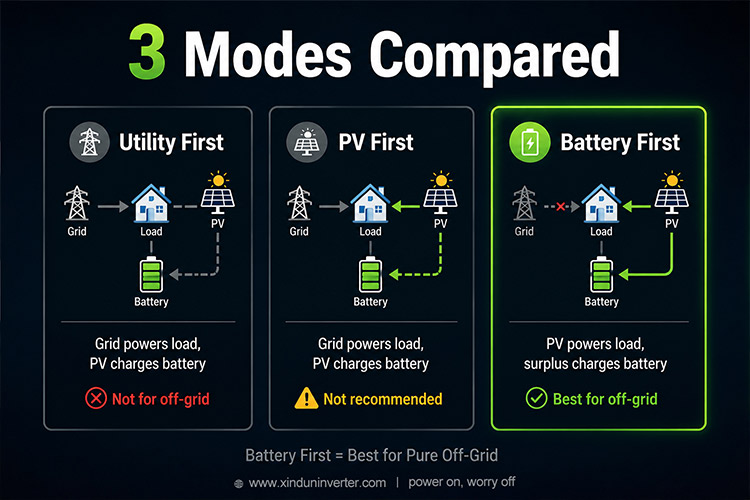
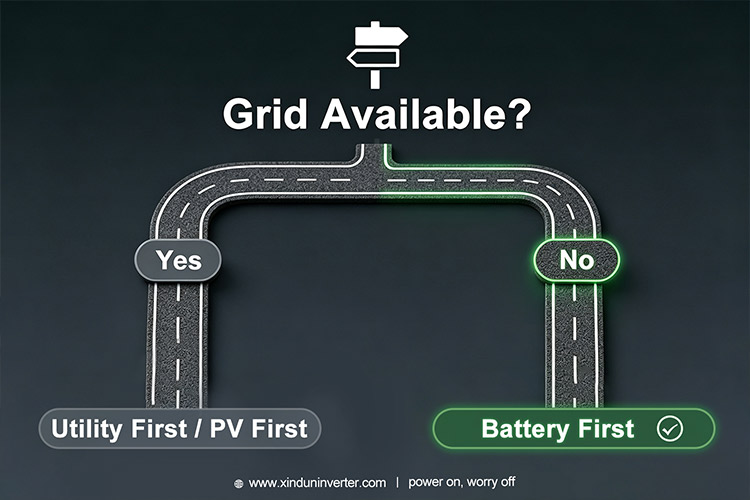
Battery First: PV Powers Load, Battery Covers Shortfall — Recommended for Off-Grid
PV energy supplies the load as a priority, with any surplus used to charge the battery. When PV power is insufficient to drive the load, the battery discharges to cover the shortfall, working together with PV to power the load. When the battery discharge voltage reaches the setpoint, the system switches to utility power to supply the load. For any off grid hybrid solar inverter operating in pure off-grid conditions, this mode delivers the best performance.
Which Output Priority Should You Choose for a No-Grid Site?
After a comprehensive comparison, for long-term, completely off-grid scenarios with no utility grid access, only the Battery First output priority aligns most closely with off-grid mode. It perfectly matches the energy structure of pure off-grid applications, maximizing PV self-consumption, reducing energy losses, and promoting healthier and more rational battery charge/discharge cycles. Under Battery First priority, PV always powers the load first, with excess energy charging the battery. When PV output is insufficient, the battery discharges to cover the deficit. Even if utility power is connected, it only serves as a backup when the battery level is too low.
In contrast, both PV First and Utility First are designed with utility grid access as a prerequisite. Under these modes, utility power takes precedence over PV and battery for supplying the load, while PV is dedicated to charging the battery. Only when utility power is completely disconnected does the system switch to "PV priority for load, surplus charging, battery supplement when insufficient." These modes are better suited for scenarios with stable utility grid access. Moreover, Xindun's HFU US-standard single-phase hybrid on off grid inverter manual explicitly advises against setting PV First output in off-grid mode.
After selecting the output priority, the charging priority is another critical aspect that cannot be overlooked in off-grid mode. Different charging priorities directly affect battery charging efficiency, degradation rate, and the system's PV self-consumption ratio. Xindun will address this in detail in a follow-up article.
Xindun Hybrid Inverter Recommendations
Xindun HFU US-Standard Single-Phase Hybrid On Off Grid Inverter (1.8kW / 3.3kW / 6.3kW)
Designed specifically for US-voltage regions, this hybrid on off grid inverter delivers AC 120V or 110V output. It supports hybrid/off-grid/grid-tied modes with flexible switching, and also allows battery-less operation. With high-frequency pure sine wave output and coordinated energy from PV, utility, and battery, it provides triple energy security. On sunny days, PV powers and charges the load throughout the day; during low sunlight, PV and utility complement each other; when both PV and utility are unavailable, the battery discharges to ensure uninterrupted power supply around the clock. As a versatile off grid hybrid solar inverter, the HFU series is built for reliability in remote installations.
In addition to the HFU series, Xindun also offers the HFP, HFP-C, HFP-E, and HFP-S series hybrid on off grid inverter models. These units output 220/230/240V AC and share all the features of the HFU series, making them suitable for a wide range of off-grid applications.
Beyond the HFP series, the HFP-C, HFP-E, and HFP-S series also include a dual-output function: two independent AC outputs (main and sub) that can power loads separately or simultaneously. This balanced, intelligent power distribution enables flexible power supply for multiple loads, meeting diverse user requirements and achieving more rational energy allocation.
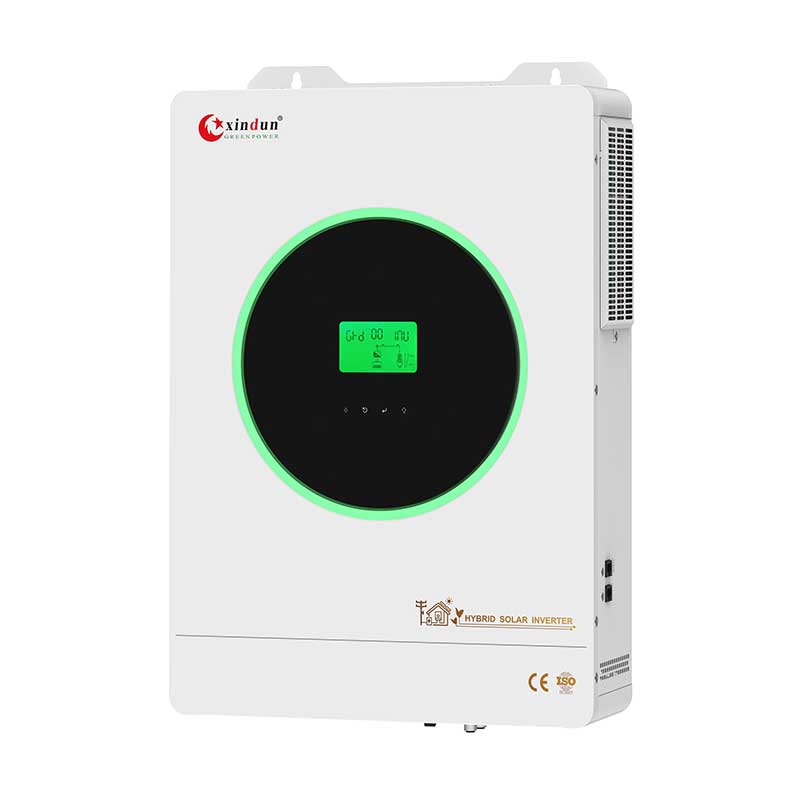
Xindun HFP-C Dual-Output Hybrid On Off Grid Inverter (4.3kW–12.3kW)
Features a circular LED RGB indicator strip design with a unique RGB light band and intelligent color indication, offering 8 customizable colors.
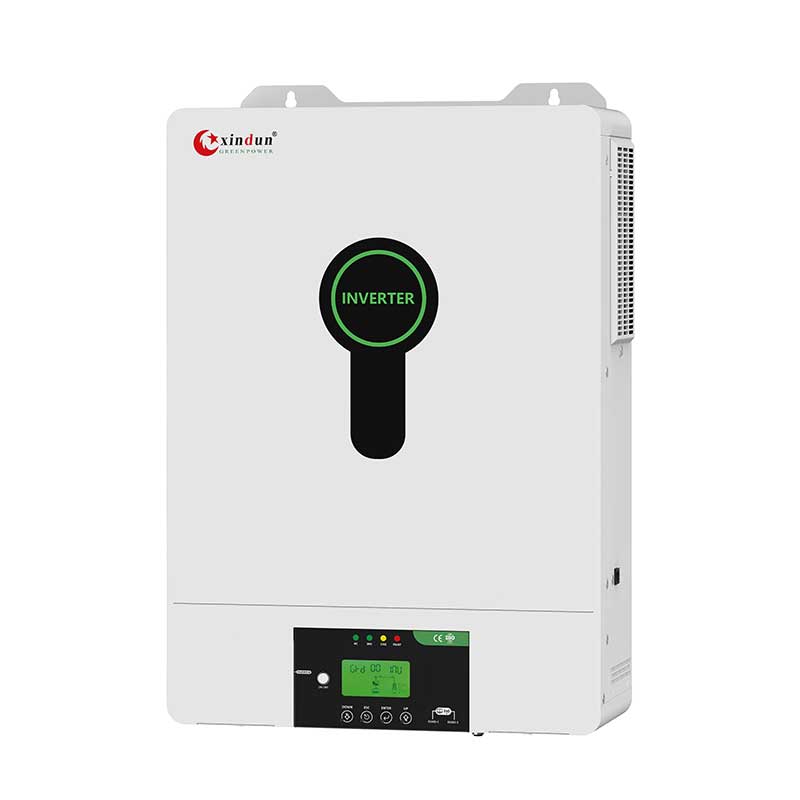
Xindun HFP-E Dual-Output Hybrid On Off Grid Inverter (3.3kW–12.3kW)
Features a detachable screen design with an external split connection option. The display panel can be easily removed and flexibly installed in a location convenient for viewing, operation, and monitoring management.
Get the Right Off-Grid Hybrid Solar Inverter for Your Project
Choosing the right hybrid on off grid inverter and configuring it with the correct output priority is essential for any off-grid power system. Whether you need a battery inverter off grid for a remote telecom site, a farm, or a residential cabin, Xindun has the expertise and product range to support your project.
If you would like to learn more about Xindun hybrid on off grid inverter solutions, please leave your information and requirements via the customer service window on our website. Xindun will get back to you as soon as possible during business hours.
 Which Charging Priority Is Best for Your Hybrid Inverter Off Grid System?
 Top Selling Products













 WeChat
 Email
Email WhatsApp