
 Solar Inverter
 Hybrid Inverter
 Power Inverter
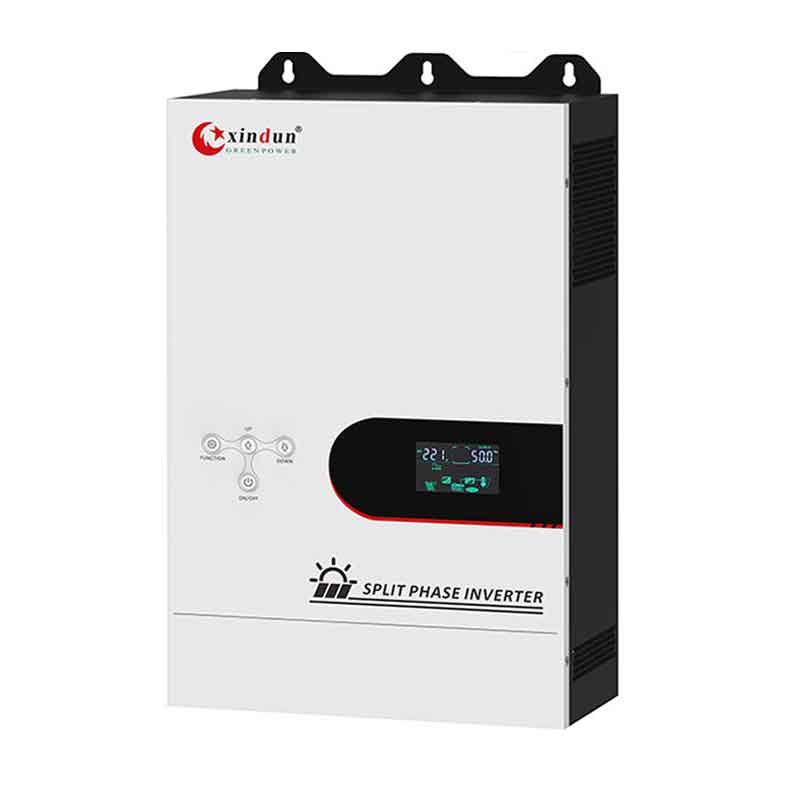
 Split Phase Inverter
 Energy Storage Inverter

 3 Phase Inverter
 Solar System Kits
 Solar Charge Controller

 Solar Battery
 Asia
Asia
 Africa

 South America
 Europe
 North America
 Oceania & Antarctica


 Inquire
 Home
HomeHow Does Split Phase Hybrid Inverter Distribute Load Power Across Its Dual Voltage Output?
 Mar 17,2026

 XINDUN
Split phase hybrid inverter is an inverter that can convert direct current into two AC voltages. Its core feature is that it can output two AC voltages with phase difference of 180°, thus simultaneously providing "phase voltage" and "line voltage".
What is phase splitting? The core of phase splitting lies in "splitting" a single AC phase into two opposing sub-phase. Taking 220V AC voltage as an example, a typical single phase inverter has two terminals, L and N, at its AC output port, resulting in AC voltage of 220V between L and N. Split phase hybrid inverter, however, has three terminals, L1, N, and L2, at its AC output port. Through special circuit design, it can output phase voltage of 110V (L1-N and L2-N) and line voltage of 220V (L1-L2).
The line voltage L1 and L2 output 220V AC voltage. L1 and L2 are 180° out of phase, and the two output is superimposed to produce 220V. This process of "splitting" single phase 220V voltage into two 110V voltage with opposite phases is called "phase splitting".
If two different voltage load devices (such as motors) with total power of 4KW and 240V AC load devices (household appliances) with total power of 3KW are used at the same time, how will the dual voltage output of the split phase hybrid inverter distribute the load power?
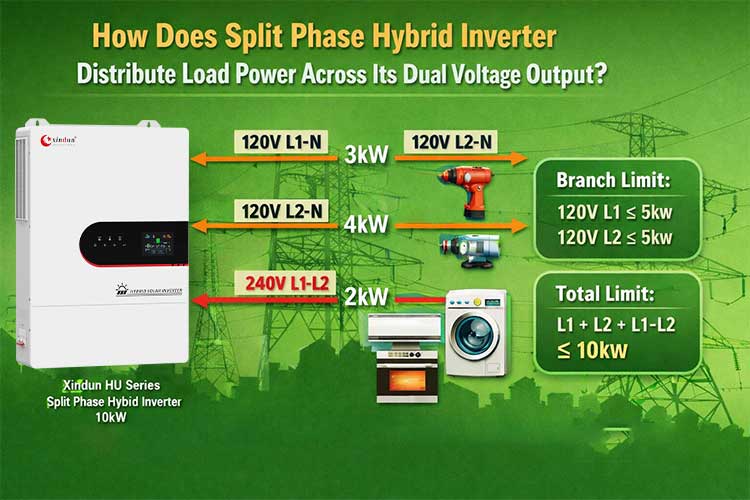
Taking the Xindun HU series 10KW split phase hybrid inverter as an example, this inverter has split phase mode. Due to factors such as circuit design matching, power balance requirements, and safety protection mechanisms, in split phase mode, L1-N and L2-N are two independent 120V power supply branches. The maximum load power of each branch does not exceed 50% of the total rated power of the inverter to ensure stable operation of the inverter.
I.Load Power Distribution of Split Phase Dual Voltage Output
1. Total Power Limit:
The sum of the power of all loads must be less than or equal to the inverter's rated power, regardless of whether the loads are 120V or 240V. The sum of the actual power of all loads must be less than or equal to the inverter's total rated power: (L1-N) + (L2-N) + (L1-L2) ≤ Total Rated Power (10KW split phase hybrid inverter).
For example, if 10KW HU series split phase hybrid inverter has loads connected to the 120V (L1-N) line with power of 3KW, 120V (L2-N) line with power of 4KW, and 240V (L1-L2) line with power of 2KW, then the total power = 3KW + 4KW + 2KW = 9KW ≤ 10KW, which is within the inverter's rated power range and meets the requirements.
If the load power of the 240V (L1-L2) equipment becomes 4KW, then the total power = 3KW + 4KW + 4KW = 11KW ≥ 10KW, which exceeds the rated power of the inverter. The split phase hybrid inverter will trigger overload protection, issue fault warning, automatically shut down the output, and stop operating.
2. Branch Power Limitation
The maximum load on the L1-N branch (120V) must be ≤ 50% of the inverter's rated power, and the maximum load on the L2-N branch must be ≤ 50% of the inverter's rated power.
The limit of ≤ 50% of the total power for each of the two L1-N and L2-N branches is "no limit for single branch," not "the total power of both branches must not exceed 50%." This prevents overload of single branch. The inverter uses hardware protection to limit the current of single branch to no more than the rated value, ensuring stable inverter operation.
3. L1-L2 Load Power Occupancy Rules
When 240V load is connected between L1 and L2 (line voltage), its load power shares the inverter's rated power quota. This will correspondingly reduce the power quota of the 120V L1-N and L2-N branches.
For example, if 10KW HU series split phase inverter has 3KW load output connected to the 240V L1-L2 (line voltage) branch, then the remaining total power = 10KW - 3KW = 7KW. This power can be allocated to L1-N and L2-N (phase voltage), meaning L1-N ≤ 3.5KW and L2-N ≤ 3.5KW.
4. Special Power Reserve for Inductive Loads
If the load is an inductive load, such as motor or laser printer, its starting power is 2-3 times its rated power. Power allocation should be calculated based on the "starting power," not the rated power.
For example, when 120V inductive load (rated 1KW, starting power approximately 2-3KW) is connected to the L1-N branch, 2KW branch power reserve (not 1KW) should be reserved to avoid branch overload during startup.
II. Power load protection of split phase hybrid inverter
Taking Xindun 10KW HU series split phase hybrid inverter as an example, if the power of single branch or the total load exceeds the limit, the inverter will trigger overload protection. The inverter will resume output after 3 minutes. After 5 consecutive overloads, the output will be shut down until the inverter restarts:
102% < Load < 110%: Error message displayed, output will automatically shut down after 5 minutes, and the inverter will stop operating.
110% < Load < 125%: Error message displayed; output will automatically shut down after 10 seconds, and the inverter will stop operating.
Load > 125%: Error message displayed, output will automatically shut down after 5 seconds, and the inverter will stop operating.
III. Practical suggestions for load power distribution
Prioritize voltage type planning: Connect to 120V (L1-N/L2-N) or 240V (L1-L2) terminals according to the load's rated voltage to avoid load burnout due to incorrect voltage connection.
Balance 120V load distribution: Try to make the 120V load power of L1-N and L2-N as close as possible to avoid long term full load operation of a single branch. If the load of single branch far exceeds 50%, it will cause power imbalance in L1 and L2 branches, leading to decreased inverter output voltage accuracy and frequency fluctuations that affect overall power supply stability.
Prioritize 240V loads: When both 120V and 240V loads are needed simultaneously, prioritize connecting the 240V load. This is because the 240V load occupies the total power quota of the 120V (L1-N, L2-N) branches. If the user is unsure of the total load power and connects the 120V branches first without proper estimation, the subsequently connected 240V load may exceed the total power and malfunction.
Allow starting power margin: Inductive loads must be calculated based on their starting power to avoid multiple inductive loads starting simultaneously and causing a sudden exceedance of the total power limit.
Monitor power via panel: The inverter display interface allows real time viewing of the load power of each branch and the total power. If the power is close to the rated value, the load should be reduced promptly.
IV. Why choose Xindun's split phase hybrid inverter?
The Xindun HU series split phase inverter (10KW/12KW) is a hybrid inverter featuring high frequency design and efficient inverter conversion output. It can be configured in hybrid、off grid and on grid modes to achieve synergistic and complementary operation of solar, grid, and battery power. It also supports batteryless operation (standalone unit).
It is also support split phase and single phase mode, making it suitable for dual voltage regions using US Standard power system, such as those in Latin America.
It can also support parallel operation of up to six inverter (60KW/72KW), with four parallel output modes: single phase parallel output, two phase split phase parallel output, split phase parallel output, and three phase parallel output. Parallel output is possible in both split phase and single phase modes, providing users with significant flexibility and scalability.
The split phase hybrid inverter also features time of use charging and discharging capabilities, with three customizable time periods. It automatically dispatches power based on your electricity usage habit, solar power generation, and local peak valley electricity prices, allowing users to flexibly set charging strategies according to price differences and solar power generation at different time.
If you would like to learn more about split phase hybrid inverter, you can leave your information and needs in the customer service window at the bottom of the website(https://www.xinduninverter.com/). Xindun will contact you as soon as possible during working hours.
 Is Split Phase Inverter Dual Voltage Output Independent?
 Top Selling Products













 WeChat
 Email
Email WhatsApp