
 Solar Inverter
 Hybrid Inverter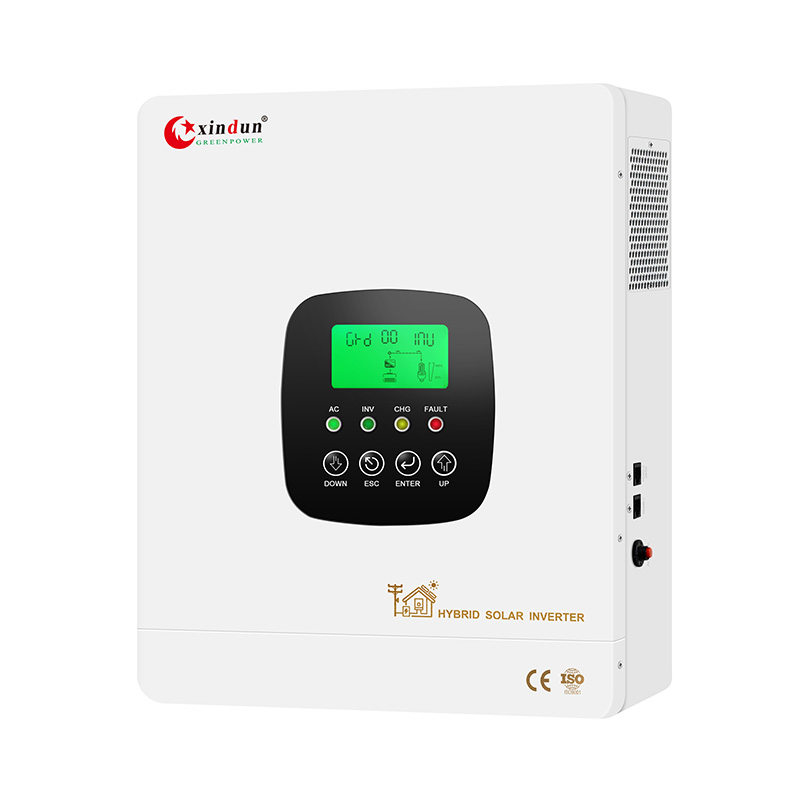
 Power Inverter
 Split Phase Inverter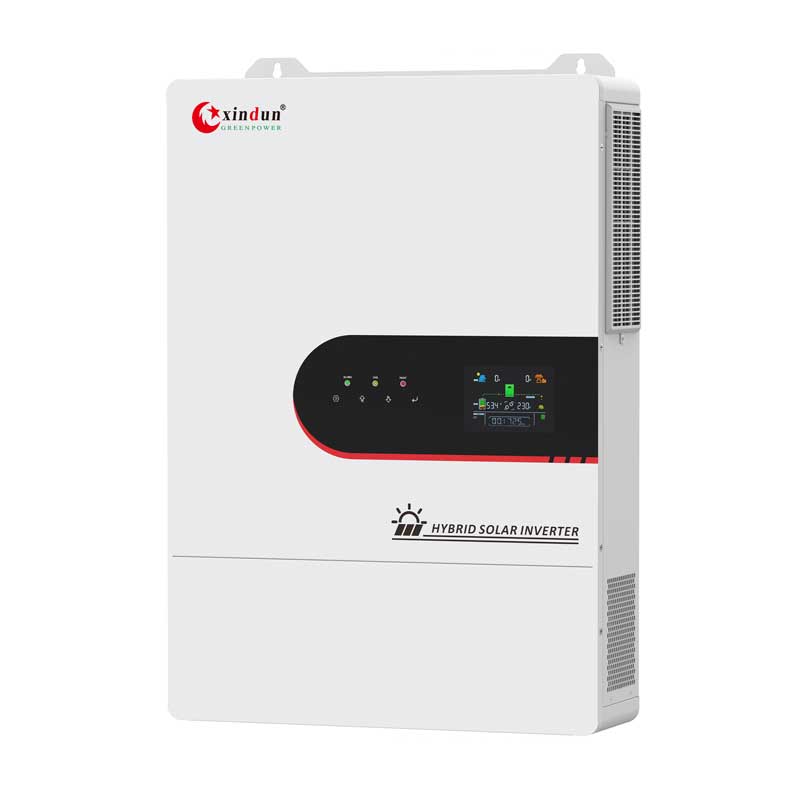
 Energy Storage Inverter

 3 Phase Inverter
 Solar System Kits
 Solar Charge Controller

 Solar Battery
 Asia
Asia
 Africa


 South America
 Europe
 North America
 Oceania & Antarctica


 Inquire

 Home
HomeCan an Off Grid Inverter Be Grid-Tied ?
 May 27,2026

 XINDUN
Many customers inquire about “grid-tied inverters” when selecting solar inverters. However, after in depth communication, we find that these customers actually do not need the function of surplus power feed in to the grid for revenue generation. Their core demand is to connect to mains power and realize complementary power supply between solar PV and mains electricity, ensuring that mains power can supplement or take over when PV power is insufficient, so that power supply to loads via the inverter remains uninterrupted.What such users really need are off grid inverters or hybrid inverter with mains power access and complementary functions.They often confuse the concepts of “grid connection” and mains power access, mistakenly believing that an off grid inverter that can connect to mains power is a grid tied inverter.
Below, Xindun breaks down this common misunderstanding to help you match your actual needs and choose the right inverter type.
First, we need to clarify a core conclusion: off grid inverters cannot achieve true grid connection. Nevertheless, some off grid inverters or hybrid inverters with mains power complementary functions can connect to the mains as a backup power source. This is fundamentally different from the core function of grid tied inverters. To clarify this distinction, we shall first understand the positioning and functions of the three main types of inverters respectively, so as to avoid selection errors.
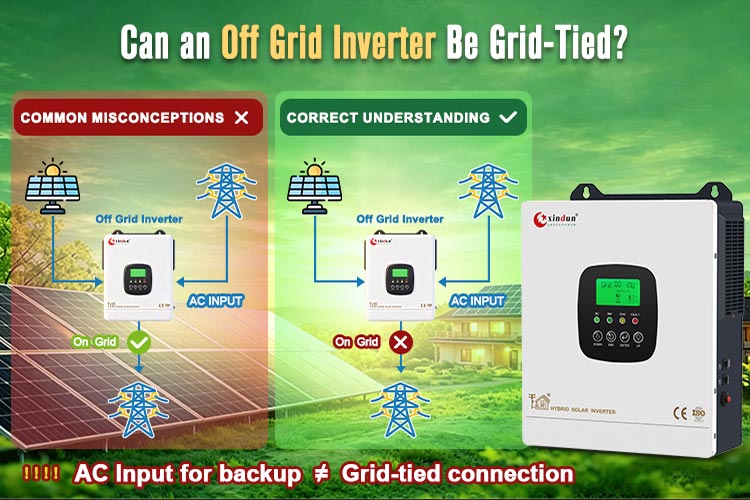
The core function of a grid tied inverter is surplus power export to the public grid.
The core design goal of a grid tied inverter is to enable coordinated operation between the PV system and the public power grid, with its key function being self consumption of generated power and export of surplus electricity to the grid. Essentially, it acts as a “partner” of the power grid.
Its working principle is as follows: it converts direct current generated by solar panels into alternating current with the same frequency, phase and voltage as the grid, which is supplied to local loads first. When PV power output exceeds load consumption, the excess electricity is automatically fed into the public grid to generate revenue. Besides, grid tied inverters must be filed with local power supply authorities.
It should be noted that grid tied inverters operate entirely relying on the public grid, with no built in energy storage capability nor mains power backup design. In case of grid blackout, for safety purposes, the inverter will activate anti islanding protection and shut down automatically to prevent reverse power feeding into the outage grid and protect maintenance personnel. Even under sufficient sunlight, it cannot power local loads.
Such inverters are only suitable for scenarios with clear demand for power selling revenue and stable grid supply, such as rural households and rooftop PV systems for industrial and commercial buildings.
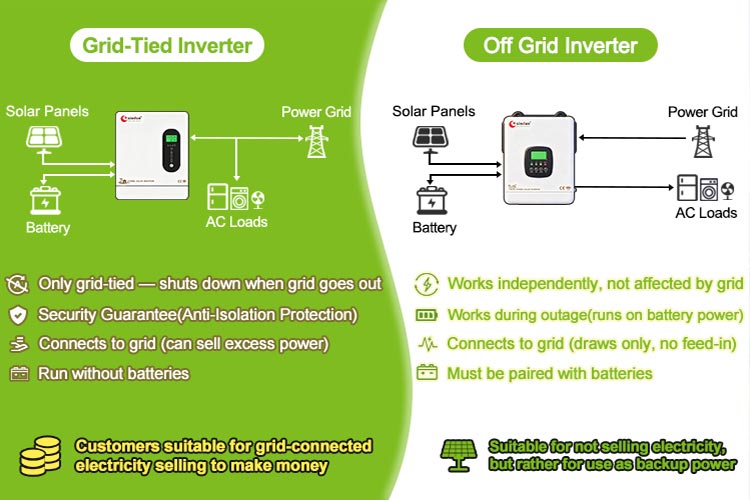
Difference between mains-power-access inverters and grid-tied inverters
Returning to the core topic of this article, the so called "grid connection" demand mentioned by customers essentially means "no power outage, with mains power backup when PV power is insufficient". This is exactly the core advantage of off grid inverters (with mains complementary function) or hybrid inverters, which is completely different from the power selling demand of pure grid tied inverters.
Hybrid inverters and off grid inverters with mains complementary function are mainly positioned as independent power supply plus mains backup. They require battery packs for operation and can run completely independently from the public grid. Even when connected to mains power, they follow the principle of power in only, no power out: they only draw electricity from the mains to supply loads or charge batteries, and never feed power back to the grid. This is the most essential difference from grid tied inverters.
A hybrid inverter integrates both grid tied and off grid functions. It can export surplus power to the grid just like a pure grid tied inverter. When the grid fails, it automatically switches to off grid mode to continue power supply via PV and batteries, while supporting mains power complementation. It is ideal for customers who want both power selling revenue and backup power during grid outages.
Both off grid inverters with mains power complementary function and hybrid inverters feature millisecond level response time for mains power switching, enabling seamless transfer that will not affect normal operation of loads at all. This fulfills the core requirement of “no waste of PV power supply and uninterrupted mains power backup”.It should be specially noted that not all off grid inverters are equipped with mains complementary function. Users shall check product specifications when purchasing to confirm whether the mains power complementary switching function and relevant parameters are available.
For example, the Xindun HFP hybrid inverter can be set to Hybrid / Off-Grid / Grid-Tied modes, allowing users to select the appropriate mode based on their actual needs. With highly flexible operation logic, it adapts to various application scenarios. When operating in Hybrid Mode, the Xindun HFP hybrid inverter enables coordinated energy management among solar PV, utility grid, and battery, with customizable priority settings for the three power sources.
PV Priority Mode: PV and mains power supply loads simultaneously. Batteries only provide power when mains power is unavailable. PV power is prioritized for load consumption. Excess PV power charges the batteries, while any power shortage from PV is supplemented by mains power. In short, loads are powered jointly by PV and mains power.
Mains Priority Mode: Mains power and PV supply loads simultaneously. Batteries only provide power when mains power is unavailable. PV power is prioritized for charging the batteries. Excess PV power supplies the loads, and any insufficient charging current from PV is supplemented by mains power to charge the batteries.
Battery Priority Mode: PV power supplies loads first. If PV power is insufficient or unavailable, batteries discharge for supplementary power, with loads powered jointly by PV and batteries. When the battery discharge voltage drops to the preset value, the system switches to mains power for load supply. When the battery is charged up to the inverter switch preset value, power supply to loads resumes from batteries.
For a more detailed introduction to the operating modes of Xindun hybrid inverters, Xindun has previously shared three articles for your reference: How to Use Hybrid Mode on hybrid inverters? (PV Output Priority), How to Use Hybrid Mode on hybrid inverters? (Mains Power Output Priority), How to Use Hybrid Mode on hybrid inverters? (Battery Output Priority).
In one sentence: If users do not need power export to the grid but require mains power access and complementary or switched power supply when PV power is insufficient, choose a hybrid inverter or an off grid inverter with mains complementary function; if users need to sell surplus electricity to the grid, choose a grid tied inverter.
Xindun Hybrid Inverter Recommendations
The Xindun HFP hybrid inverter is a high frequency on off grid hybrid solar inverter. It supports flexible switching among Hybrid, Off Grid and On Grid modes, and can operate without batteries. It provides high frequency pure sine wave output and realizes coordinated energy complementation among PV, mains power and batteries to deliver triple layer energy security. When sunlight is sufficient during the day, loads are fully powered and batteries are charged by PV; when sunlight is poor, power is supplied jointly by PV and batteries (DC); when PV and batteries run out of power, mains power takes over seamlessly, ensuring stable and uninterrupted round the clock power supply for your loads.
Besides the Xindun HFP hybrid inverter, Xindun also offers other hybrid inverter series including HFP C, HFP S, HFP E and HP PLUS+. Among them, the HFP C, HFP S and HFP E models retain all functions of the HFP series and are additionally equipped with dual output capability. The main and auxiliary AC outputs can drive loads independently or simultaneously. With balanced and intelligent power supply, they can power different devices at the same time, flexibly meeting users’ multi load requirements and achieving more rational power distribution.
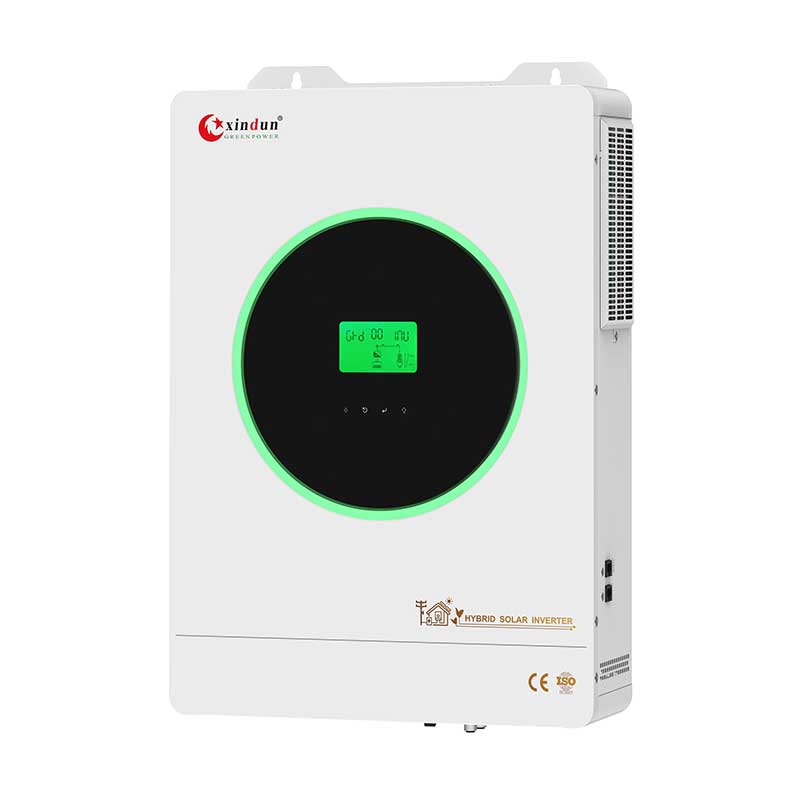
Among them, the Xindun HFP C dual output hybrid inverter features an annular RGB LED light strip design. With its unique RGB light strip and intelligent color indication, 8 colors can be customized.
The Xindun HFP E dual output hybrid inverter adopts a detachable display screen design, and the screen module supports external split connection. Users can easily remove the inverter’s display panel according to actual application needs, and flexibly install it at positions convenient for observation, operation, monitoring and management.
The Xindun HP PLUS+ hybrid inverter (10 kW/12 kW) supports parallel connection. Up to 6 inverters can be paralleled for single phase or three phase output, delivering a maximum total output power of 60 kW/72 kW. It offers excellent flexibility and scalability, especially suitable for scenarios requiring phased expansion of power systems.
This series also supports time of use charge discharge settings with three customizable time periods, helping users fully take advantage of peak valley electricity price differences to effectively reduce power consumption costs.
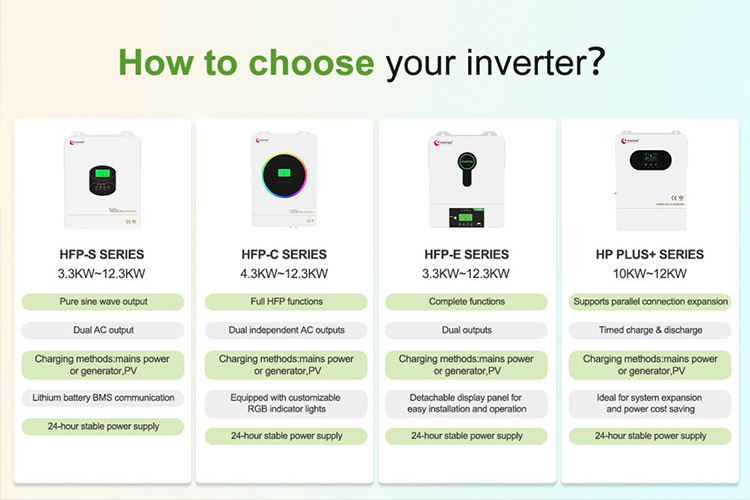
All Xindun HFP, HFP C, HFP S and HFP E hybrid inverters feature an AC output voltage of 220/230/240 V. However, many overseas countries and regions adopt the US standard voltage (110 V or 120 V AC). In such cases, the Xindun HFU US standard single phase hybrid inverter (3.3 kW/6.3 kW) is highly suitable. Specially designed for regions with US standard voltage, it outputs 120 V AC and shares exactly the same functions as the Xindun HFP series, making it a practical and cost effective US standard inverter.
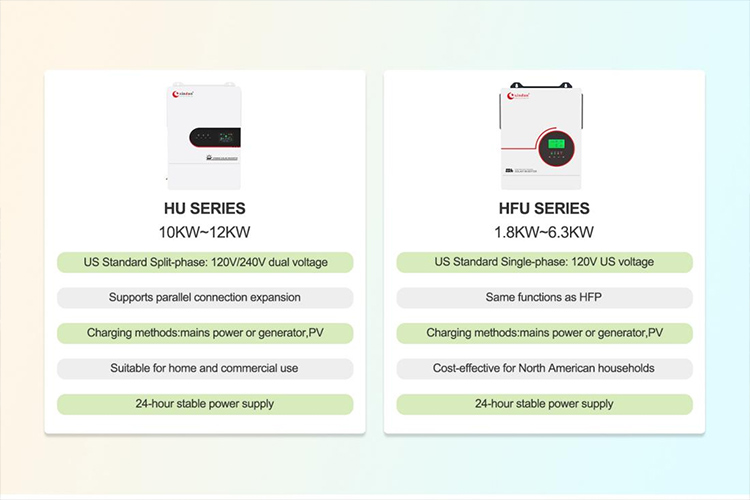
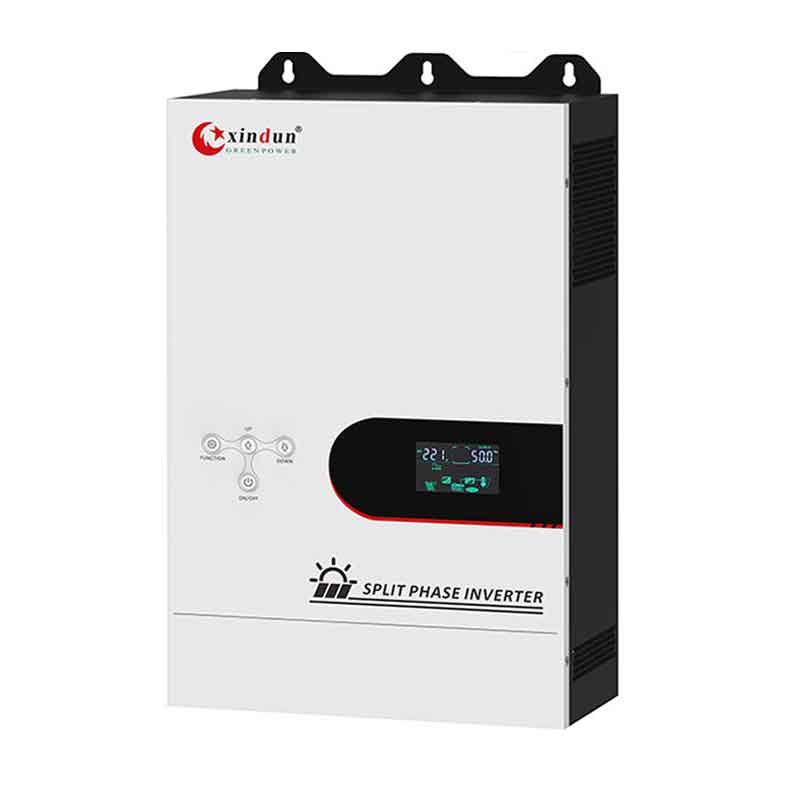
Besides US standard single phase models, split phase hybrid inverters are also available. The Xindun HU US standard split phase hybrid inverter (10 kW/12 kW) supports both split phase and single phase modes, delivering dual voltage outputs of 120 V and 240 V, as well as time of use charge discharge settings. Moreover, up to 6 units can be paralleled for capacity expansion (60 kW/72 kW). It supports parallel connection in single phase, two phase split phase, split phase and three phase modes, providing reliable power supply for both residential and commercial industrial applications.
For more information about Xindun hybrid inverters, please leave your details and requirements via the customer service window at the bottom of our website. Xindun will contact you promptly during working hours.
 Why Do Customers Prefer Low Frequency Inverters?
 Top Selling Products













 WeChat
 Email
Email WhatsApp