
 Solar Inverter
 Hybrid Inverter
 Power Inverter
 Split Phase Inverter
 Energy Storage Inverter

 3 Phase Inverter
 Solar System Kits
 Solar Charge Controller

 Solar Battery
 Asia
Asia
 Africa
 South America
 Europe
 North America
 Oceania & Antarctica


 Inquire

 Home
Home120V 240V Split-Phase Hybrid Inverter Settings | Off-Grid Mode Power Strategy
 Jun 25,2026

 XINDUN
How to set the optimal power supply strategy for an US standard split phase hybrid grid inverter in off-grid mode? Follow Xindun Power to learn more.
As residential PV storage systems and off-grid power systems continue to expand in overseas markets, hybrid inverters with multi-energy management capabilities have become the core choice for many home pv power systems. Taking the Xindun HU split-phase hybrid inverter as an example, its coordinated complementary power supply from PV, utility grid, and batteries significantly improves system reliability, energy efficiency, and operational economy.
Three core settings on the hybrid inverter — operating mode, output priority, and charging priority — determine the entire system's energy supply and dispatch sequence. The Xindun HU split-phase hybrid inverter offers 3 operating modes (Hybrid / Off-Grid / Grid-Tied), 3 output priority levels ( PV Priority / Utility Priority / Battery Priority), and 4 charging modes (SNU / CUB / CSO / OSO) for configuration.
Since Hybrid Mode on the HU series automatically locks output priority, charging priority, and input voltage range — leaving little room for manual adjustment — this article focuses on optimal power strategies in Off-Grid Mode, tailored to different power needs and application scenarios.
Compared to the locked parameters of Hybrid Mode, Off-Grid Mode on the Xindun HU split-phase hybrid inverter offers maximum flexibility, with all core operating parameters adjustable manually. However, it is important to note that output priority and charging priority cannot be combined arbitrarily. Proper compatibility between these two parameters directly affects whether PV, grid, and batteries can operate in coordinated stability — and more importantly, whether users can achieve cost savings, emergency backup, and battery protection.
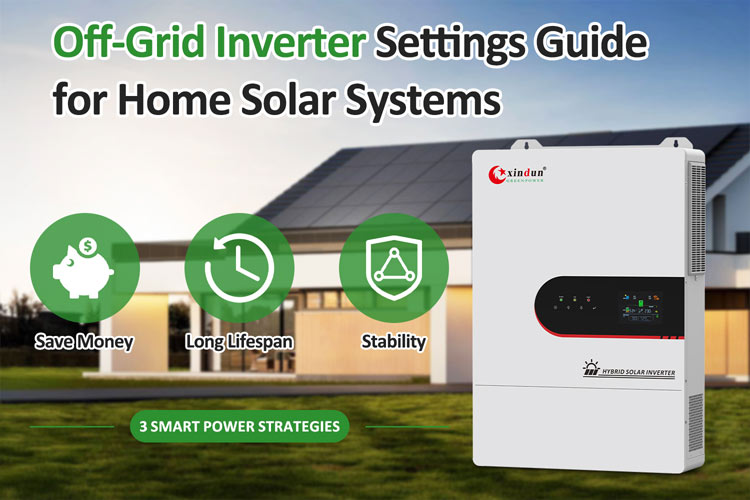
Based on common user goals — saving electricity costs, extending battery life, and ensuring stable power supply — we have compiled three typical parameter combinations for Off-Grid Mode to suit different use cases, helping you get the most out of your off-grid pv system for home use.
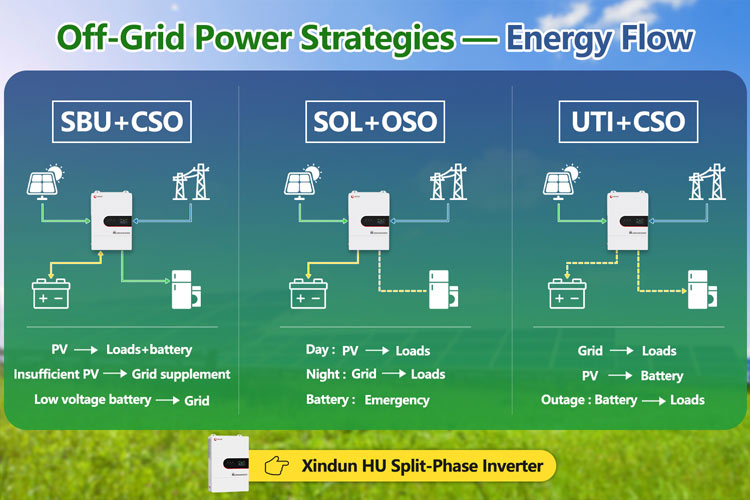
1. Battery Priority Output + PV Priority Charging (SBU + CSO)
This combination is the preferred configuration for cost-conscious households. The entire operating logic is highly consistent: PV priority powers loads first, with grid as backup. During the day, PV powers household loads, with excess stored in the battery. At night, the battery discharges to power loads. The grid barely intervenes, except when the battery level drops to the set switchover point — only then does the grid take over.
Scenario example:
During the day, PV generates 6000W. Loads consume 2000W, leaving 4000W stored in the battery. At night, PV drops to zero, and the battery begins discharging to power household loads. Late at night or early morning, when battery voltage drops to the set grid switchover point, the inverter instantly switches to grid power — which powers loads and charges the battery. Once the battery charges back to the set recovery point, the system immediately switches back to battery inverter mode.
This combination maximizes PV utilization during the day, minimizes grid consumption, and significantly reduces electricity bills — perfectly matching the goal of saving on electricity costs.
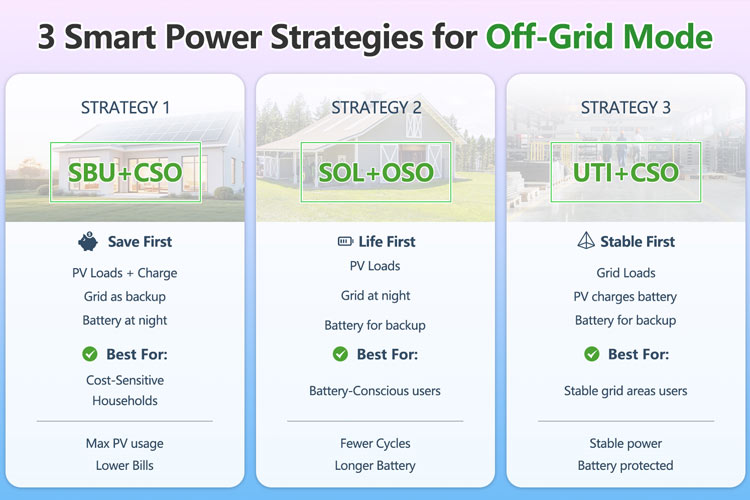
2. PV Priority Output + Only pv Charging (SOL + OSO)
For users who want to minimize battery charge-discharge cycles and extend battery lifespan — using the battery only as emergency backup during outages — the "SOL + OSO" combination is optimal. The two modes are highly complementary. In "SOL" ( PV priority output) mode, loads are entirely powered by PV during the day, switching to grid power at night, with the battery remaining idle. "OSO" (Only pv Charging) prevents the grid from charging the battery — the battery can only be recharged by PV the next day. Only in the event of simultaneous PV and grid failure will the battery automatically discharge to power loads. In short: PV powers loads by day, grid powers loads by night, battery for emergencies only. This is a classic configuration for off-grid pv system for home users who prioritize battery health.
Scenario example:
During sunny days, PV powers loads and charges the battery. On cloudy days, when PV is insufficient, the system automatically switches to grid power. At night, grid power supplies all loads. The grid does not charge the battery — only PV does the next day. If a blackout occurs at night, in the extreme case of both PV and grid failing, the battery automatically discharges to power loads.
This combination significantly reduces battery charge-discharge cycles, avoids unnecessary wear, and effectively extends overall battery lifespan.
3. Utility Priority Output + PV Priority Charging (UTI + CSO)
For users with limited PV panels and overall generation capacity — but who require high supply continuity and stability without frequent power source switching — the "UTI + CSO" combination is ideal. The two roles are clearly divided: grid exclusively powers loads, PV exclusively charges the battery, and the battery serves as emergency storage. As long as the grid is available, loads are always powered by the grid, with the battery kept idle. When PV is available, it prioritizes battery charging. On cloudy/rainy days or at night without PV, the grid automatically charges the battery. This approach works well for smaller PV storage systems where generation is limited.
Scenario example:
On a sunny morning, the battery is at 50% SOC. PV generation begins, the grid continues powering loads, and PV charges the battery at full capacity. By midday, PV reaches peak power and the battery quickly reaches full charge. The grid continues powering loads, while the battery enters float or idle state. In the evening, PV drops to zero, and the grid continues powering loads. If a sudden blackout occurs at night, the inverter instantly switches to battery power for critical loads — refrigerators, routers, monitoring devices, etc. — ensuring uninterrupted operation. When grid power returns, the system switches back to grid power, and PV resumes battery charging the next day.
If the grid fails during the day, the system automatically switches to PV powering loads, with excess PV continuing to charge the battery. When grid power returns, it automatically switches back to grid for loads, while PV continues battery charging.
This combination clearly separates grid power for loads and PV for charging — ideal for small PV systems in stable grid areas. It provides stable power for sensitive equipment while reducing unnecessary battery cycling and effectively delaying battery aging.
Conclusion
The three typical Off-Grid Mode parameter combinations above can be precisely matched to different user needs. On this basis, users can also combine time-of-use charging functions, flexibly selecting the most suitable power strategy based on PV capacity, local grid stability, electricity cost goals, and battery usage plans — ensuring efficient, economical, and stable system operation.
This article uses the Xindun HU split-phase hybrid inverter as an example to introduce different off-grid mode setting strategies. Different manufacturers may implement these functions differently, so users should carefully read the product manual to fully understand the various operating modes and features before using the inverter effectively.
Xindun Hybrid Inverter Recommendations
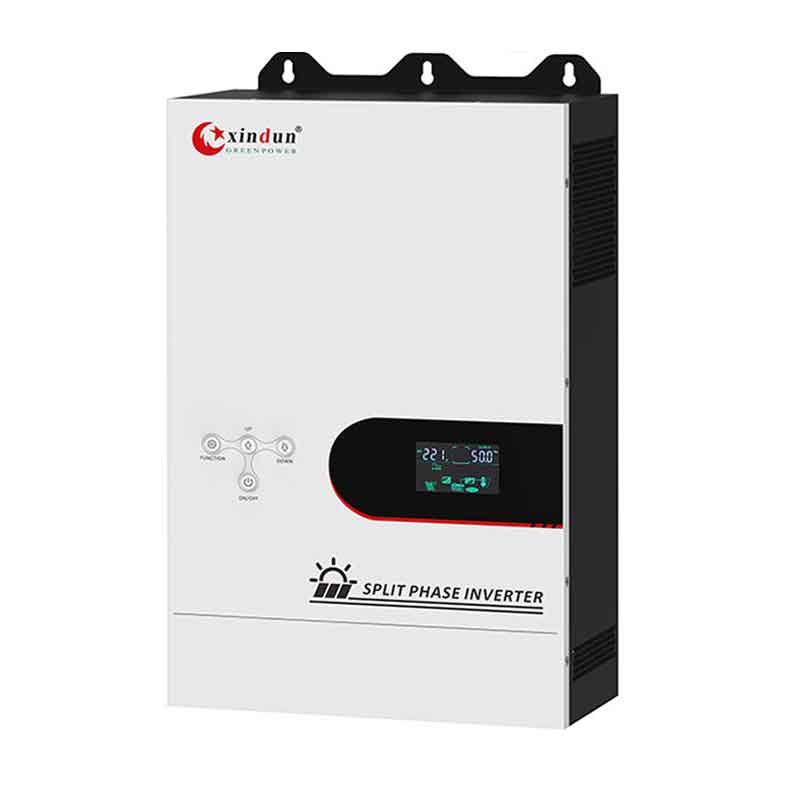
The Xindun HU series (10kW/12kW) is a high-frequency split-phase hybrid inverter with pure sine wave output. It offers both split-phase and single-phase modes, delivering dual voltage output of 120V and 240V (or 110V and 220V) in split-phase mode.
It supports flexible switching among Hybrid, Off-Grid , and Grid-Tied modes, with battery-free operation available. PV, utility grid, and batteries work together in coordinated complementarity — triple-layer energy security: full PV power during peak sunlight; PV + grid supply during low sunlight; battery backup when both PV and grid are unavailable, ensuring 24/7 uninterrupted power for your loads. This makes it an ideal choice for both off-grid power systems and grid-tied PV storage systems.
The inverter also features time-of-use charge/discharge settings for peak shaving and time-shift storage needs. Additionally, it supports parallel operation — up to 6 units can be paralleled to expand output to 60kW/72kW, with four parallel modes available: single-phase, two-phase split-phase, split-phase, and three-phase. Whether in split-phase or single-phase mode, free parallel expansion provides excellent flexibility and scalability for both residential and commercial applications.
For more information about Xindun split-phase hybrid inverters, please leave your details in the customer service window at the bottom of our website. Xindun will contact you as soon as possible during working hours.
 110V 220V Split-Phase Hybrid Inverter | Hybrid Mode Working Logic Guide
 Top Selling Products













 WeChat
 Email
Email WhatsApp