
 Solar Inverter
 Hybrid Inverter
 Power Inverter
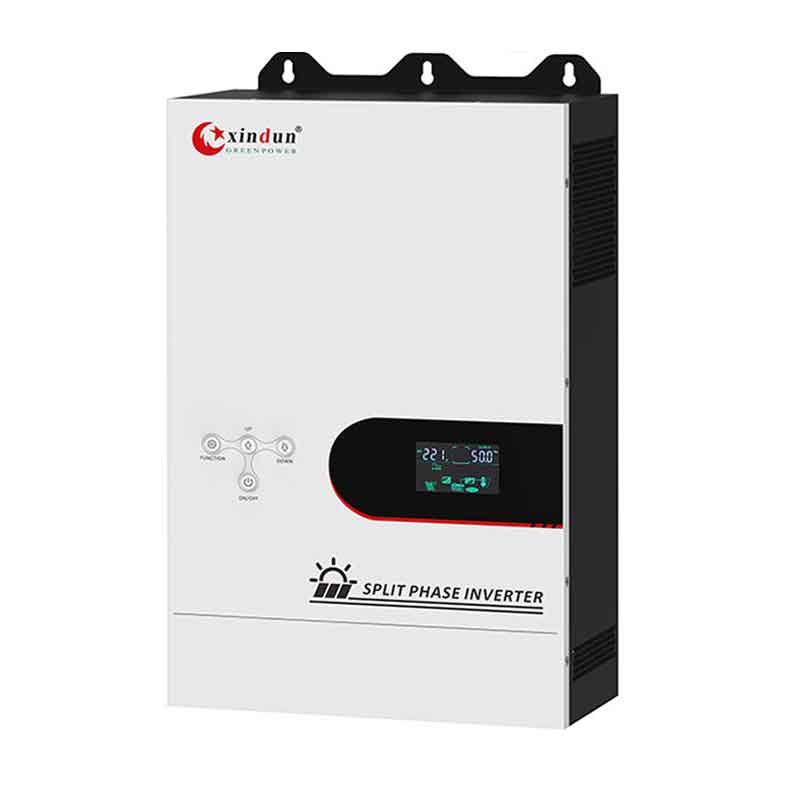
 Split Phase Inverter
 Energy Storage Inverter

 3 Phase Inverter
 Solar System Kits
 Solar Charge Controller

 Solar Battery
 Asia
Asia
 Africa

 South America
 Europe
 North America
 Oceania & Antarctica


 Inquire
 Home
Home110V 220V Split-Phase Hybrid Inverter | Hybrid Mode Working Logic Guide
 Jun 30,2026

 XINDUN
Our previous article introduced the different setup strategies for the off-grid mode of the Xindun HU split phase inverter. While the off-grid mode offers flexible configuration options, some users prefer a simpler approach – they just want a straightforward setup and let the system run. The hybrid mode offers exactly that: once configured, the inverter automatically locks three key parameters – output priority, charging priority, and AC input voltage range – leaving only one fine-tuning option: the "PV energy priority" setting.
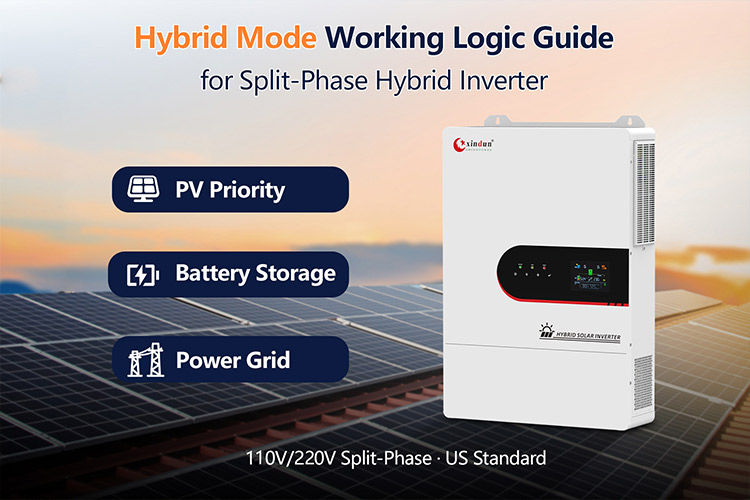
In this article, Xindun will walk you through the complete hybrid inverter working principle in hybrid mode, along with practical hybrid inverter settings for different user needs.
Hybrid Mode Function
To understand the hybrid inverter working principle in this mode, here's a one-sentence summary: PV and grid power work together to supply loads. PV-generated power is used first to power the loads, and any excess PV energy – instead of being fed back to the grid – is stored in the battery as part of your PV energy systems. When PV power is insufficient to cover the loads, the grid automatically supplements the shortfall and works together with PV to power the loads.
Parameters Auto-Locked in Hybrid Mode
For users who want to simplify their hybrid inverter settings, the HU series automatically locks the following three parameters once hybrid mode is activated:
Output Priority – "UTI" (Utility Priority) – The grid must remain connected at all times, serving as the voltage reference. The system continuously monitors PV power output and precisely controls the difference between PV and grid power to prevent load disconnection.
Charging Priority – "SNU" (Hybrid Charging) – The system dynamically schedules both PV and grid power to serve as the primary charging source in real time, ensuring flexibility in power dispatching.
AC Input Voltage Range – "UPS" (90–140V) – When the output voltage is set to 110/120V, the AC input voltage range is locked to 90–140V. This wide range maximizes tolerance to grid voltage fluctuations and minimizes unnecessary switching – a key consideration in hybrid inverter settings for regions with unstable grids.
PV Energy Priority
In hybrid mode, the "PV energy priority" setting offers two options: CHG (PV Priority Charging) and LOD (PV Priority Load). This is where users can fine-tune their hybrid inverter settings to match specific usage patterns.
Users can use this setting to determine the internal usage order of PV energy – and this is the primary user-customizable setting in this mode. Understanding this option is essential to grasping the full hybrid inverter working principle in hybrid mode.
CHG (PV Priority Charging) – PV power is used first to charge the battery, strengthening your PV energy systems; excess energy is then directed to power the loads.
LOD (PV Priority Load) – PV power is used first to supply loads; when PV is insufficient, the grid automatically compensates; any surplus is then used to charge the battery.
These two "PV energy priority" settings determine whether PV energy is prioritized for charging the battery or for powering the loads – giving you flexibility in how you manage your PV storage systems.
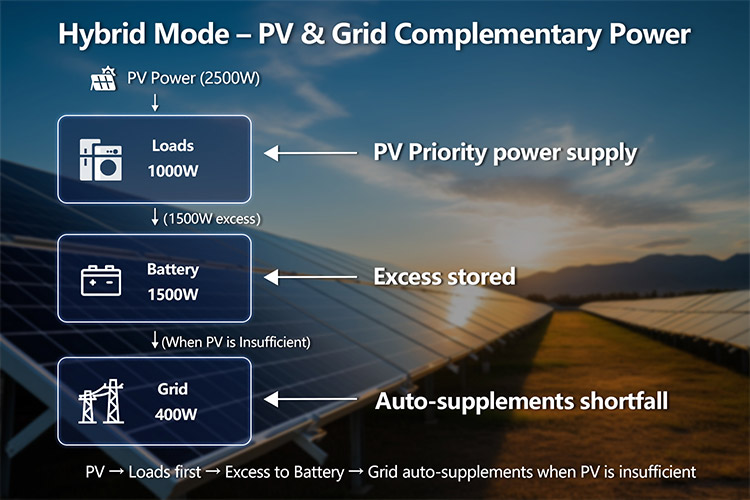
Hybrid Mode – Real-World Scenarios
Assume a household load requires 1000W. PV generation is 2500W. Battery is currently at 60% SOC. Based on the inverter's hybrid mode settings, this breaks down into two scenarios:
Scenario 1: "PV energy priority" set to CHG (PV Priority Charging)
The split phase inverter directs the 2500W of PV power to charge the battery first, while the 1000W load is powered entirely by the grid. After the battery is fully charged, PV begins shifting to support loads. If PV generation remains at 2500W, the load consumes 1000W, and the remaining 1500W – since the battery is full and reverse power flow is not allowed – is curtailed. If PV generation drops to 600W after the battery is fully charged, the grid automatically supplies the 400W shortfall to cover the load, and the battery stays fully charged and on standby.
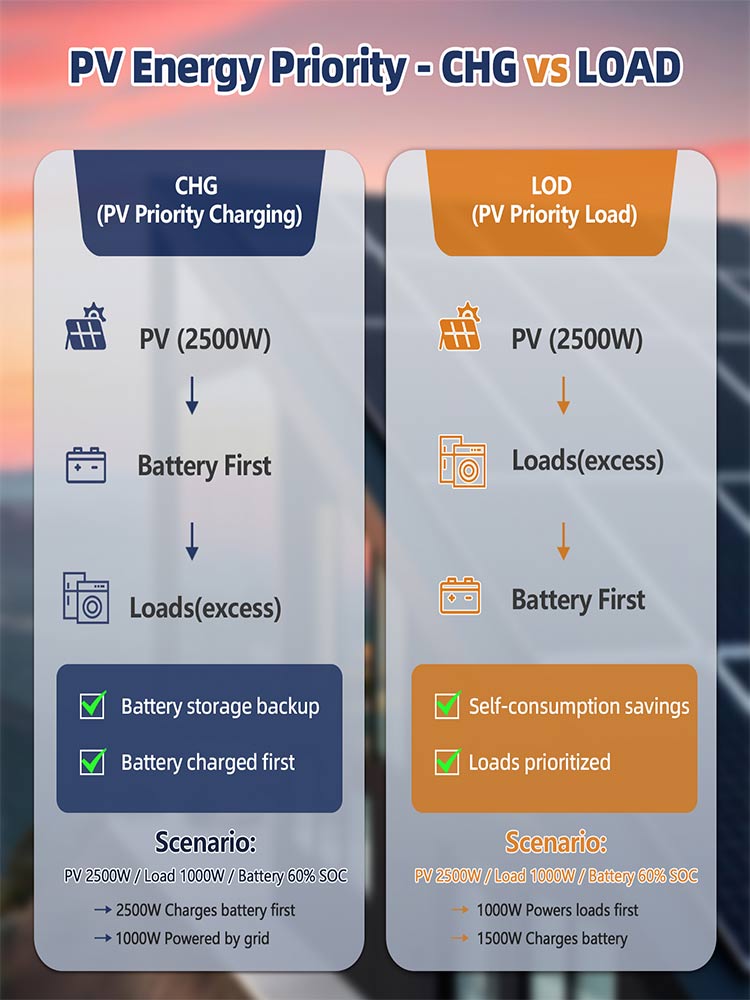
Scenario 2: "PV energy priority" set to LOD (PV Priority Load)
The split phase inverter directs the 2500W of PV power to the 1000W load first, and the remaining 1500W is used to charge the battery. After the battery is fully charged, if PV generation remains at 2500W, the battery can no longer accept charge – to prevent reverse power flow to the grid, the inverter actively limits PV output to match the current load demand (1000W). If PV generation drops to 600W after the battery is fully charged, the grid automatically supplies the 400W shortfall to cover the load, and the battery stays fully charged and on standby.
Conclusion
The Xindun HU split phase inverter features auto-locked parameters in hybrid mode, requires no complex tuning, and is simple and hassle-free to use. Understanding the hybrid inverter working principle behind these auto-locked settings helps users make informed decisions. Simply set the "PV energy priority" – by toggling between "CHG (PV Priority Charging)" and "LOD (PV Priority Load)" – and you can flexibly adapt to either battery storage backup or self-consumption savings needs. The inverter coordinates PV, grid, and battery in real time, delivering complementary hybrid power supply. When PV is insufficient, the grid automatically compensates; when the battery is full, the system prevents reverse current flow. It operates reliably and stably – making it an excellent addition to home PV energy systems and small commercial PV installations.
This article uses the Xindun HU split phase inverter as an example to explain the hybrid inverter working principle of the hybrid mode. Hybrid inverters from different manufacturers may vary in functionality, so users should carefully read the product manual to fully understand the various operating modes and features. Only by mastering the inverter's working characteristics and operational logic can users make the most of their hybrid inverter settings and optimize their PV energy systems.
Xindun Hybrid Inverter Recommendations
The Xindun HU inverter (available in 10kW and 12kW models) is a high-frequency hybrid inverter featuring pure sine wave output. It supports both split-phase and single-phase operating modes. In split-phase mode, the split phase inverter delivers both 120V and 240V (or 110V and 220V) simultaneously – perfectly suiting the diverse electrical needs of the US and North American markets.
In terms of operating modes, the inverter supports three working states: hybrid mode, off-grid mode, and grid-tied mode – giving users the freedom to switch based on real-world application scenarios. It can also operate without a battery, further enhancing system adaptability. The device integrates PV, grid, and battery into a coordinated, complementary power supply, forming a three-layer energy backup mechanism for reliable PV storage systems. The system automatically adjusts its strategy based on sunlight and grid conditions: during the day with good sunlight, PV powers the loads and charges the battery; under poor sunlight conditions, PV and AC work together to supply loads; in extreme cases where neither PV nor grid is available, the battery automatically takes over to provide continuous power to loads, ensuring uninterrupted power supply.
In terms of functional expansion, the Xindun HU split phase inverter features time-of-use charging/discharging settings, helping users achieve peak shaving and time-shifted energy storage to further optimize energy efficiency. The device also supports parallel expansion, with up to 6 units connectable in parallel – expanding system capacity to 60kW or 72kW to meet larger load requirements. Parallel output offers four configuration options: single-phase, two-phase split-phase, split-phase, and three-phase. Regardless of whether operating in split-phase or single-phase mode, users can flexibly configure parallel units based on actual needs, enabling free system capacity expansion – greatly enhancing the device's applicability and flexibility. Whether for residential homes or small-to-medium commercial facilities, the Xindun HU series delivers stable, reliable power protection for diverse PV energy systems needs.
For more detailed specifications, application cases, or custom solutions for the Xindun inverter, feel free to leave a message via our website live chat or contact form, or call our purchasing hotline. Xindun will get back to you promptly.
 How to verify solar inverter certifications (CE and UL) before selecting a Chinese supplier in 2026
 Top Selling Products













 WeChat
 Email
Email WhatsApp